



Veteran Yoruba thespian Chief Lere Paimo, popularly known as Eda Onile Ola, has firmly countered claims by Nollywood icon Pete Edochie that his professional acting career ranks among the earliest in Nigeria, insisting he took to the stage in 1958—four years before Edochie’s reported debut.

The 86-year-old actor, born on 19 November 1939 in Ogbomoso, Oyo State, made the assertion during an interview with fellow actor Kunle Afod, which was posted on YouTube on Monday. Paimo’s remarks come amid a renewed public debate over seniority among Nigeria’s veteran performers, sparked when Edochie recently challenged colleagues who claimed earlier starts to prove their assertions.
Edochie, born on 7 March 1947 and now 79, has repeatedly stated that his acting journey began in 1962 at the age of 15. As a student at St. John’s College in Kaduna, he performed in a school production of William Shakespeare’s The Merchant of Venice. In recent podcast appearances, including on Curiosity Made Me Ask, the Things Fall Apart star emphasised that this stage work predated the formal emergence of Nollywood, which many date to the early 1990s with films such as Living in Bondage. He has invited any actor asserting greater professional seniority to come forward publicly, noting that his screen breakthrough as Okonkwo in the 1985 NTA adaptation of Chinua Achebe’s novel further cemented his place long before the home-video boom.
Paimo, however, places his own entry earlier still. “I started acting in 1958,” he said. “I met Hubert Ogunde, who was senior to me and others, and there were big movies produced back then.” He stressed that he was already active when Edochie began in 1962.
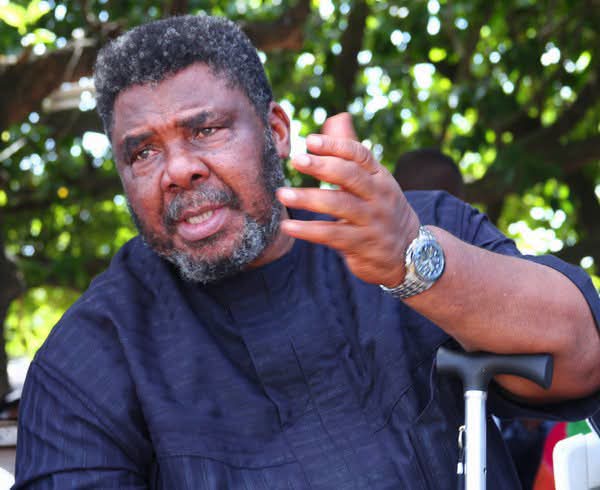
The Ogbomoso-born performer entered the profession through the vibrant Yoruba travelling-theatre tradition. While working as a classroom teacher at a Baptist Missionary School in Osogbo after training in the then Gold Coast (now Ghana), he joined the Oyin Adejobi Theatre Group around 1958–1960. The group, founded by the veteran practitioner Pa Oyinade Adejobi, staged performances for churches, schools, and cultural clubs across the region. Paimo later moved to Duro Ladipo’s Theatre Group at the invitation of the celebrated dramatist, appearing as Chief Basa in the stage production Obamoro. His memorable portrayal of the central figure in a Yoruba adaptation of the morality play Everyman (titled Eda) earned him the enduring nickname Eda Onile Ola.
Wider recognition followed with his lead role as Soun Ogunola (also rendered Ogunlola) in the epic Ogbori Elemosho, a landmark production centred on the founding of Ogbomoso that brought him national prominence in the early 1960s. Over subsequent decades he acted in, produced and directed numerous films, including titles such as Oleku, Saworoide, Agogo Ewo and Arugba. In 2005, then-President Olusegun Obasanjo conferred on him the national honour of Member of the Federal Republic (MFR) in recognition of his contributions. He later established his own troupe, continuing a career that has spanned stage, traditional performance and screen.

Paimo used the interview to underscore the deeper historical roots of indigenous Nigerian theatre. He pointed to the late Hubert Ogunde (1916–1990), widely regarded as the father of modern Nigerian and contemporary Yoruba theatre, who founded the country’s first professional theatrical company—the African Music Research Party—in 1945 (later known as the Ogunde Theatre). Ogunde’s early works, beginning with the 1944 folk opera The Garden of Eden and the Throne of God and continuing with politically charged pieces such as Strike and Hunger (1946) and Yoruba Ronu (1964), blended traditional music, dance, satire and social commentary. His travelling company performed across Nigeria and West Africa, professionalising a form that had earlier roots in Alarinjo masquerade traditions.
“I heard from history that when he (Hubert Ogunde) started in the ’40s, there was nobody before him, and we never heard from history that the English industry, or any movie done in the English language, started before him,” Paimo said. “Since we didn’t hear or read that in any history books or documentation, I believe the Yoruba industry started first. There was nothing like English-speaking movie production then; Ogunde started by producing movies in the Yoruba language, which he used to educate everyone who watched those movies back then.”
He also addressed speculation about other early practitioners such as Baba Olumegbon, noting that while he had long heard of the figure, he regarded Ogunde as the pioneer he personally knew and could confirm as senior.
The exchange forms part of a broader conversation that has included other veterans. Actor Yemi Solade has similarly argued that Yoruba-language performance traditions predated and contributed to the foundations of what later became known as Nollywood, while acknowledging Edochie’s seniority in age.
Industry observers note that the debate often turns on definitions—whether school or amateur stage work, professional travelling theatre, radio and television drama, or commercial film production counts as the formal start of a career—and on the relative visibility of English-language versus indigenous-language streams of Nigerian performance history.
Paimo’s intervention highlights the enduring influence of the mid-20th-century Yoruba travelling theatre movement, which produced not only Ogunde, Adejobi and Ladipo but also a generation of performers who transitioned into film and helped shape popular culture long before the digital and home-video eras. At 86, the actor remains a living link to that tradition, continuing to embody the continuity between oral storytelling, professional stagecraft and contemporary Nigerian cinema.
Do you want to advertise with us?
Do you need publicity for a product, service, or event?
Contact us on WhatsApp +2348033617468, +234 816 612 1513, +234 703 010 7174
or Email: validviewnetwork@gmail.com
CLICK TO JOIN OUR WHATSAPP GROUP