



JUBA, South Sudan — The question in Juba this week was not whether Major General Atem Salva Kiir deserved his new command.
The question was whether anyone else could ever have been considered.On September 8, 2026, President Salva Kiir Mayardit appointed his 36-year-old son, Major General Atem Salva Kiir, as commander of the Tiger Division, the elite presidential guard responsible for protecting the president and senior government officials.
On Thursday, the younger Kiir formally assumed command, promising to “address their concerns, improve working conditions, strengthen discipline, and support meaningful reforms”.
The appointment, according to the army, “followed normal command channels”.
The phrase itself is a tell.
When a military command has to publicly insist that a promotion was normal, it is almost certainly anything but.
Atem was promoted from brigadier general to major general just a week earlier.
Before that, he commanded the Special Force within the Internal Bureau of the National Security Service, a unit that answers directly to the presidency, not the army.
He joined the security services in 2012.
He is not the first of Kiir’s children to be placed in a strategic position.
His sister, Adut Salva Kiir, was appointed Senior Presidential Envoy for Special Programmes in August 2025.
Two of his brothers were promoted to ambassadors in May 2025.
Another was appointed deputy executive director in the Office of the President in November 2024.
This is not an anomaly. It is a pattern.
And it is a pattern that stretches across a continent.
The Museveni Precedent
If Salva Kiir is studying a template, the clearest one sits in Kampala.
President Yoweri Museveni, who has ruled Uganda since 1986, has spent two decades elevating his son, Muhoozi Kainerugaba, through the military ranks.
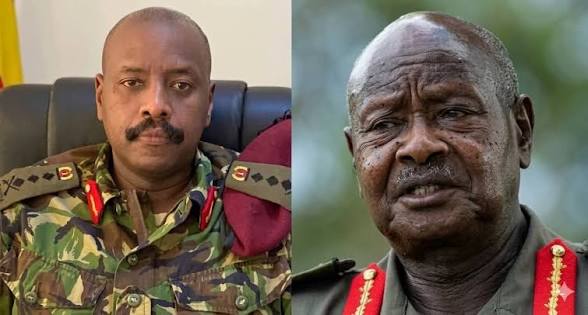
Muhoozi was commissioned as a Second Lieutenant in 2000 after training at Sandhurst.
He was promoted to Major the following year by Muammar Gaddafi. On Saturday, May 12, 2001, an aide to Libyan leader Col. Muammar Gaddafi announced that Gaddafi had promoted Muhoozi to the rank of Major.
This was a two-step jump, skipping the rank of Captain entirely.
The promotion was made without consultation with the UPDF’s Promotions and Commissions Board or the Commander-in-Chief, President Museveni.
This created immediate confusion within the army, with colleagues unsure how to address Muhoozi, who was still wearing the pips of a 2nd Lieutenant days later.
The UPDF army spokesman at the time, Lt. Col. Phinehas Katirima, stated that while the promotion was “not unlawful” as there was no specific law barring a foreign dignitary from rewarding an officer, it was an action that would “call for debate on the way forward”.
He also noted that such promotions by foreign heads of state were “not uncommon”.
By 2019, he was a Lieutenant General.
In February 2024, Museveni named him Chief of Defence Forces, the top military commander in the country.
The logic is not accidental.
Scholars of African political dynasties have identified two principal reasons why leaders place their sons in elite military units: first, to secure the regime against coups by ensuring the protective apparatus is controlled by bloodline; second, to legitimise eventual political succession by giving the heir-apparent the high-ranking military credentials necessary to command respect from generals who served alongside his father.
As one analysis put it: “In organisations such as the military where seniority commands automatic respect, no senior officers, including the generals who served alongside his father, can dare challenge him in the open”.
This is not unique to East Africa.
In Cameroon, President Paul Biya has positioned his son, Franck Biya, within the political establishment.
In Congo-Brazzaville, President Denis Sassou-Nguesso appointed his son Denis-Christel as a cabinet minister.
In Zimbabwe, President Emmerson Mnangagwa’s son, Sean Mnangagwa, serves as a Lieutenant Colonel.
In Rwanda, President Paul Kagame’s son, Ian Kagame, is a Captain in the Special Forces.
The history runs deeper still.
In 1967, Zambia’s Kenneth Kaunda sent his son Panji to Sandhurst. Panji became an officer in the Zambian Army.
His brother Wezi served in the military before entering politics and was assassinated at the age of 47.
The fear is not imaginary.
Coups are a historical fact of African military life.
From the 1960s onwards, military takeovers became the most common mechanism of regime change across the continent.
Leaders who came to power through force of arms; Museveni in Uganda, Kagame in Rwanda, Kiir in South Sudan, know better than most that the gun is the ultimate arbiter of political power.
Placing a son at the head of the presidential guard is not merely nepotism.
It is a calculated insurance policy against the very institution that brought them to power.
The Command Structure Problem
But there is a cost to this calculation.
And the cost is paid by the military itself.
Military institutions do not operate like civilian bureaucracies. They are built on a rigid hierarchy of seniority, merit and professional advancement.
Officers spend decades climbing the ranks.
They attend staff colleges, accumulate command experience, and wait their turn.
When a 36-year-old leaps over officers who have served for twenty years, the message is unmistakable: blood matters more than competence.

The South Sudan People’s Defence Forces have already faced criticism over discipline and professionalism.
The appointment of the president’s son to command its most elite unit is unlikely to strengthen those institutions.
It may, in fact, do the opposite.
The Tinubu Parallel: A Lesson in What Happens When the Coup Fear Meets the Institution
If African leaders fear coups, they also fear the reaction of the military when they try to circumvent its processes too blatantly.
The recent experience of Nigeria’s President Bola Tinubu offers a case study.
In late 2025, Tinubu approved a “special presidential promotion” for his aide-de-camp, Colonel Nurudeen Yusuf, elevating him to the rank of brigadier-general, a one-star general, less than a year after he was decorated as a colonel.
Under normal Nigerian Army procedures, an officer must serve as a colonel for at least four years and attend the National Defence College before being considered for promotion.
The approval bypassed the standard process and was conveyed in a letter from the National Security Adviser’s office to the Chief of Army Staff.
The promotion was scheduled to be formalised on a Monday evening.
It never happened.
Two former chiefs of army staff intervened at the last minute, persuading Tinubu to shelve the decoration because of “the dangers to the military establishment”.
The Minister of Defence, Chris Musa, a retired general, and the Chief of Army Staff, Lieutenant General Waidi Shaibu, cut short a visit to Lagos and returned to Abuja in anticipation of the ceremony that would not hold.
A presidential source said the promotion was not going to happen “anytime soon”.
Military experts had warned that it would set a “bad precedent”.
Yusuf had already been accused of wielding undue influence over military postings and promotions because of his closeness to the president.
The lesson was clear: even in a country where the president is the commander-in-chief, the military’s institutional memory and its retired generals remain a formidable check on arbitrary power.
The Nigerian case demonstrated that the military, when pushed, can push back.
South Sudan’s military is a different institution.
It is younger, more fragmented, and more deeply politicised.
The mechanisms that allowed Nigeria’s retired generals to intervene may not exist in Juba.
But the principle remains: a military that is not governed by its own rules is a military that is waiting to be governed by someone else’s.
The Election Context
The timing of Atem Kiir’s appointment is not incidental. South Sudan is scheduled to hold elections on December 22, 2026, the sixth proposed election date since the constitution first promised a vote in 2015.
President Kiir has been in power since independence in 2011.
He has postponed elections repeatedly.
Do you want to advertise with us?
Do you need publicity for a product, service, or event?
Contact us on WhatsApp +2348033617468, +234 816 612 1513, +234 703 010 7174
or Email: validviewnetwork@gmail.com
CLICK TO JOIN OUR WHATSAPP GROUP
His government has appointed a dead man to an election committee.
The country’s economy is buckling under falling oil revenue and a weakening currency.
In this context, the appointment of a son to command the presidential guard is not a military decision.
It is a political one.
It is a message to potential rivals, inside the army and outside it, that the Kiir family controls the guns.
It is a message that the December election, whatever its outcome, will not change who holds power.The question is whether the message will be received as reassurance or as provocation.
The Enduring Question
The fear of coups is real. It has shaped African politics for sixty years.
But the solution to the fear of military intervention cannot be the further politicisation of the military.
A president who places his son at the head of the presidential guard is not protecting the state. He is protecting himself.
And in doing so, he is weakening the very institution he claims to lead.
South Sudan’s Tiger Division is now commanded by the president’s son.
The army says the appointment followed normal channels. The rest of the world knows better.