



There is something strangely funny about watching Nigerians argue about whether a young woman should call Tony Elumelu “Tony.”
We are a people who can insult a man as “this useless man” in a WhatsApp group and, five minutes later, meet him physically and say, “Good afternoon, sir.”
We can call a politician every unprintable name imaginable behind his back, yet when he walks into the room, suddenly it is,
“Your Excellency, good afternoon, sir.”
So perhaps the internet should calm down.
The viral exchange between United Bank for Africa Group Chairman Tony Elumelu and a young graduate trainee is not really about whether the word “Tony” is offensive.
It is about something much more interesting.Who gets to call you by your first name?
And perhaps more importantly:When does familiarity become appropriate? The young woman, during an interactive session at the UBA Graduate Management Accelerated Programme graduation ceremony, greeted Elumelu with, “Good morning, Tony.”
He stopped her.
“No, you won’t call me Tony. You’ll call me Mr. Elumelu or TOE. You won’t call me Tony, or Chairman. I don’t subscribe to that kind of… Oyinbo life, okay?”
The internet, naturally, did what the internet does. One side declared that the young lady had committed an unforgivable act of disrespect.
The other side asked what exactly was wrong with calling someone by his first name in a modern corporate environment.Then came the inevitable question:“
But doesn’t everybody call him Tony?”
Ah. Now we are getting somewhere.
Because the answer is yes, sometimes.
And that is precisely why this conversation is worth having.
Wait. Haven’t We Heard “Tony” Before?
Here is where I must complicate the argument.
If I were simply defending Elumelu by saying,
“He is an elder, therefore everybody must call him Mr. Elumelu,” I would be ignoring evidence.
In 2022, Tony Elumelu appeared at Stanford Graduate School of Business as part of its prestigious View From The Top speaker series.
The format is worth noting. It is not a village meeting. It is not a family gathering. It is a formal university event where students interview prominent leaders before a live audience.
The interviewer was Chisom Obi-Okoye, an MBA student. And she began:
“Hi, Tony. It’s so great to have you here.”Elumelu did not stop her. He did not say, “Excuse me, young lady, that is Mr. Elumelu.”
He simply replied, “Good to meet you, too.”
Later in the interview, Chisom repeatedly addressed him as “Tony.” Elumelu continued answering her questions without objection.
The Stanford transcript records the interaction plainly.

So let us be intellectually honest. Tony Elumelu does not universally reject being called Tony. We know that. And that changes the conversation.
At Stanford, a young woman called him Tony and he accepted it. In Nigeria, a young woman called him Tony and he corrected her.
Same man. Same first name. Different woman. Different country. Different institutional environment. Different relationship. Different cultural setting. Different outcome.
That is not a contradiction we should hide. It is the entire point.
Maybe “Tony” Is Not the Problem
Perhaps the question is not whether Elumelu likes the name Tony. Clearly, he does. The question is whether you have been invited to use it.
That is a completely different proposition.
There is a huge difference between somebody saying, “My name is Tony,” and somebody saying, “Call me Tony.”
The first is identification. The second is permission. That distinction is lost on many young professionals today.
They hear someone being called “Tony” by one person and conclude that everybody has now received a Tony-passport.
No. That is not how human relationships work.
If I meet your mother and hear your older brother call her by her first name, that does not automatically give me the same privilege.
If I see your boss chatting casually with another employee and saying, “Just call me James,” I should not immediately stroll into the office the next morning and announce,
“James, I need that report.”
That may be perfectly acceptable. It may also be the fastest route to discovering that James has different rules for different relationships.
The intelligent person watches first.
Maya Angelou Already Gave Us the Lesson
This is where the late Maya Angelou enters the conversation.
Years ago, a young woman named Kim Watts attended a taping of the television programme People Are Talking. She was 20 at the time.
When she got an opportunity to ask Maya Angelou a question, she addressed the celebrated author simply as “Maya.”
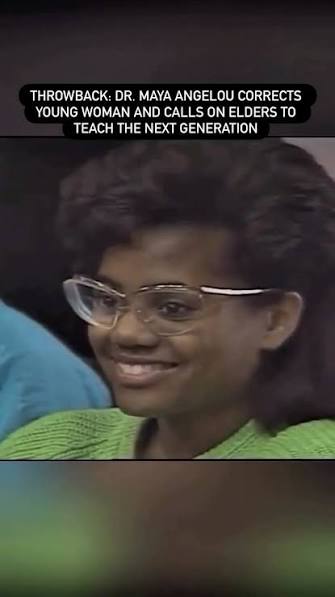
Angelou stopped her.“I’m Ms. Angelou. I’m not Maya,” she told her, before explaining that the young woman had no license to address her by her first name.
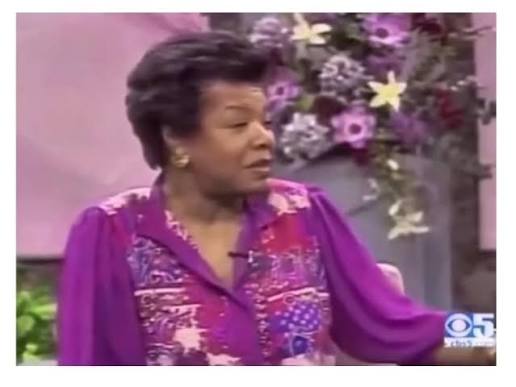
The video has resurfaced decades later and generated a fresh argument about manners, age, race, culture and generational expectations.
And there is something important about what happened afterward. Angelou herself later apologised for the manner in which she delivered the correction.
The young woman, Kim Watts, also reflected on the incident years later and said she had felt she had insulted one of her icons.
That is a useful lesson for both sides. The young person can make a genuine mistake. The older or more senior person can establish a boundary.
And neither event needs to become a war.
The First Name Should Be an Invitation
This is the principle I have come to believe in. The first name should be an invitation, not an assumption.
If Maya Angelou says, “Call me Maya,” then call her Maya.
If Tony Elumelu says, “Call me Tony,” call him Tony. If he says, “Mr. Elumelu is fine,” then use Mr. Elumelu.
If your professor tells you, “Please call me Yemi,” you can call him Yemi. Until then, Professor Yemi is not going to kill you.
In fact, it might save you. The problem with our generation is that we sometimes confuse informality with sophistication.
We think calling a senior executive by his first name makes us look confident.
Sometimes it does. Sometimes it makes us look like somebody who has not read the room.
And there is nothing sophisticated about being confidently wrong.
But Was the Young Woman Really Wrong?
Here is where I want to defend the young woman. Yes, she may have got the social cue wrong. But I don’t think we should turn an etiquette mistake into a character assassination.
Young professionals receive all kinds of advice and trainings. Some of it is good. Some of it is spectacularly terrible.
Several years ago, a senior university mate advised me to pack 25 passport photographs for NYSC camp in Gombe State. He had recently passed out of the scheme.
Naturally, I trusted him. He also told me not to bother carrying beverages.
So I arrived at camp. Guess what? I needed only four passport photographs. Four. Not 25.
Meanwhile, other corps members had provisions I had been specifically told not to bring. That bad advice cost me comfort for weeks.
I learned something important. Experience is useful. But somebody else’s experience is not necessarily your reality.
That young woman may have been told and trained that modern corporate culture operates on a first-name basis.
She may have been taught that hierarchy should not prevent communication.
She may have seen other people call Elumelu “Tony.”
She may even have been trained in an organisational environment where first names are encouraged.
Indeed, one social media reaction cited by Pulse claimed that graduates of the training were taught to address people by their first names.
That claim is not something I would present as established fact without confirmation from UBA, but it shows the kind of expectation that may have shaped the young woman’s assumption.
So before we call her rude, perhaps we should ask a more useful question: What did she think the rules were?
She made an assumption. Elumelu corrected the assumption. She moved on. That should have been the end of the story.
And Elumelu Was Right About One Thing
The young woman may not have known what Elumelu preferred. Now she knows. That is how social learning works.
What I found interesting about his correction was that he did not simply say, “Don’t call me that.” He gave alternatives.
“Mr. Elumelu.”“TOE.”“Chairman.”
In other words: Not this. Try this instead.
That is actually a useful form of correction.
He established the boundary and allowed the programme to continue. He did not demand that she kneel. He did not insult her intelligence. He did not order her out of the room.
He corrected the form of address. And she adjusted. That is what a correction should accomplish.
But Elumelu Also Gives Us a Problem
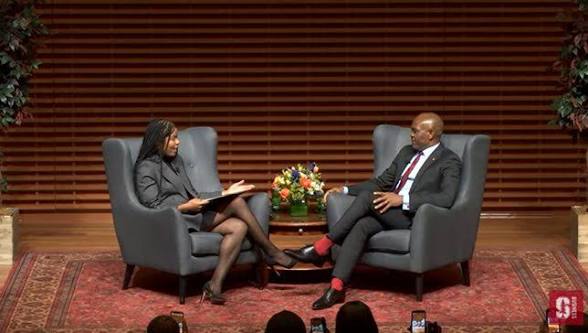
Now let us return to Stanford. This is where I refuse to turn this article into a fan club.
At Stanford, a young female MBA student called him Tony. Repeatedly. He did not object.
The official Stanford transcript records it. And the setting was formal enough to make the comparison interesting.
View From The Top is Stanford Graduate School of Business’s premier speaker series, where students interview prominent leaders from around the world before live audiences.
So if somebody asks: “But Mr. Elumelu, why was it acceptable there?”
That is a fair question. Maybe the answer is culture. Maybe it is the nature of the Stanford programme. Maybe the interviewer had been given an informal mandate to engage him that way. Maybe Elumelu simply felt comfortable with it in that environment. Maybe he had already accepted the convention of that particular setting. Maybe it was the relationship. Maybe it was all of these things.
We don’t know.
And unless Elumelu explains the difference himself, we should not manufacture an explanation on his behalf.
But we can observe something. He understands that context matters. And perhaps that is the lesson we should take from the two encounters.
America Is Not One Giant First-Name Society
There is another lazy argument I would like us to retire. “Oyinbo people call everybody by their first names.”
No.
Which Oyinbo people? Where? When?
In what context?
America is not culturally monolithic.
In parts of the American South, “sir” and “ma’am” remain deeply embedded in everyday etiquette.
Southern Living, in an article updated in July 2026, notes that these forms remain common in the South, even though their use varies significantly across different American communities.
The publication describes “sir” and “ma’am” as conventional signs of respect, particularly toward older people or people in positions of authority.
The same article gives a delightful picture of this cultural difference.
A writer who grew up in Memphis describes telling her children to switch on their “Memphis manners” when they return to the South from New York.
Suddenly, the “yes, ma’am” and “no, sir” come out. Same children. Same country. Different social environment.
That is culture.
And it is not uniquely American.
The American South Understands Something We Sometimes Forget
In some Southern communities, respect is built into speech. A young person may address an older person as “sir” or “ma’am” without feeling oppressed by the vocabulary.
The purpose is not necessarily to establish that the older person is better. It is to acknowledge social position.
And this has historical depth.“Sir” itself comes from an old European honorific associated with rank and position.
Over time, it evolved into a broader term of respectful address. Southern culture retained much of that formal linguistic tradition even as other parts of America became more relaxed.
So when somebody tells you that first-name culture is simply what “advanced societies” do, please don’t believe everything you hear. The sophisticated person understands that advanced societies also have manners.
They simply express them differently.
Britain Has Its Own Version
Britain provides another useful lesson. British business etiquette guidance has traditionally advised people to wait before switching to first names.
The University of Bristol’s business etiquette guidance, for example, advises people to wait to use first names until the other person uses theirs or explicitly invites first-name address.
Contemporary British workplaces have certainly become more informal. But the principle remains useful: Don’t assume familiarity before it has been established.
There is a reason formal introductions still exist. There is a reason titles exist.
There is a reason people say “Doctor,” “Professor,” “Mr,” “Mrs,” “Ms,” “Judge,” “Your Honour,” “Chairman” and other forms of address.
Language tells us something about relationships.
Respect Is Not Fear
This is perhaps where we need the biggest correction. Calling someone “sir” does not mean you are afraid of him. Calling someone “Mr. Elumelu” does not mean you believe he is more human than you.
Calling a younger person respectfully does not make you inferior. I have always understood respect this way.
From my teenage years, I moved in circles where many of the people around me were considerably older. Because I was often treated as unusually mature for my age, I sometimes found myself in environments where first-name familiarity could easily have become normal.
But I never took it for granted. Even when somebody said, “Don’t call me sir,” I still often did.Not because I was afraid.
Because respect had become part of my posture. I have addressed people younger than me with the same courtesy I would give someone considerably older.
Why?
Because respect is not something I give only to people above me.It is something I choose to carry.
I Learned That From an Unpleasant Experience
Years ago, a senior staff member at my secondary school nearly jeopardised my WASSCE enrolment because of an error in my records. The man was haughty. He was dismissive.
And, frankly, he was unnecessarily difficult.
When I got home and explained everything to my parents, I told them that I had remained courteous despite the way he treated me.
Then I said something that surprised even me.
I said: “He isn’t even as old as my elder sister B. But I gave him all the respect I would give her, and more, because of his position.”
He eventually apologised to me.
That experience clarified something about how I see people. I don’t give respect only because somebody is old. I give respect because the person is a person.
Do you want to advertise with us?
Do you need publicity for a product, service, or event?
Contact us on WhatsApp +2348033617468, +234 816 612 1513, +234 703 010 7174
or Email: validviewnetwork@gmail.com
CLICK TO JOIN OUR WHATSAPP GROUP
Sometimes I respect the office. Sometimes I respect the responsibility. Sometimes I respect the person’s accomplishments. Sometimes I simply respect humanity.
We Africans Have Been Doing This Long Before LinkedIn
There is something deeply African about how we arrange people mentally. We see someone and immediately begin calculating the relationship.
“That’s my elder brother’s age.”“She is my mother’s age.” “This one is my child’s age.” “That person is like my uncle.”
And suddenly we know whether to say “sir,” “aunty,” “uncle,” “brother,” “sister” or simply their name.It is our social operating system.
And no, it is not always perfect. Sometimes it creates unnecessary hierarchy. Sometimes it makes young people afraid to speak. Sometimes people abuse titles and demand reverence they have not earned.
But the underlying instinct is not foolish.It recognises something modern corporate culture occasionally forgets:Relationships have context.
I Saw It Again at My Father’s Fidau
At my late father’s Fidau prayers years ago, a young lady greeted me warmly. Naturally, I greeted her back with respect. Later, I discovered that she was a close friend of my youngest sister.
Even now, whenever she comes around during family occasions, I still address her respectfully. Sometimes she and her friends laugh and say: “Ah, Brother Yomi, we are your little sisters o!”
I laugh too.
But I don’t suddenly abandon courtesy because we have established familiarity.
Why?
Because respect is not about who is older. It is about who you choose to be.
And This Is Where Young Professionals Need to Pay Attention
There is a dangerous trend among young professionals. We have been taught to be confident. Good. We have been taught to speak up. Excellent. We have been taught not to be intimidated by titles. Absolutely.
But somewhere along the line, some people have confused confidence with familiarity. They are not the same thing.
You can challenge a managing director without calling him by his first name.
You can disagree with a professor without calling her by her first name.
You can contribute intelligently in a room full of senior executives while still saying “sir” or “ma’am.”
You can be brilliant without being unnecessarily casual.
In fact, knowing how to navigate different levels of formality is a professional skill.
Call it social intelligence. And social intelligence can save you from embarrassing situations that intelligence alone cannot.
So What Should the Young Professional Do?
When you enter a new organisation, don’t immediately copy what you see. Observe. Who calls the managing director by his first name?Who doesn’t? Who has known him for 20 years?Who joined last week? Who is a friend? Who is a subordinate? Who is a client? Who is a board member? Who is a journalist? Who is a family member?
Those distinctions matter. If you are unsure, ask. “Sir, how would you prefer I address you?”
That sentence will not make you look stupid. It will make you look socially intelligent.
And if the person says, “Please, call me Tony,” congratulations.
You have just been granted the Tony licence. Use it responsibly. Do not photocopy it for your friends.
The First Name Is Not a Human Right
Perhaps we need to say this plainly. Nobody is entitled to somebody else’s first-name familiarity. Not because the person is rich.
Not because the person is old. Not because the person is famous. Simply because names are personal.
The person decides how they want to be addressed.If they invite you to use their first name, wonderful.If they prefer a title, respect that. If they change their preference depending on the context, respect that too.
Because that is what personal boundaries are.
But There Is Also a Lesson for People Like Elumelu
Yes, the young should learn. But older and more senior people should learn too. If you expect young professionals to understand your preferred form of address, make the culture clear.
If your organisation genuinely operates on first-name terms, train people properly.
If you personally prefer “Mr. Elumelu” in certain settings, say so.
And when someone gets it wrong innocently, correct them without destroying their dignity.
Maya Angelou’s story is instructive because she eventually acknowledged that her delivery could have been better.
Elumelu’s correction, for all the internet drama around it, also contained something useful: he gave the young woman alternatives and allowed her to continue.
That is mentorship at its best.Correct the behaviour without destroying the person.
Perhaps Elumelu’s “Oyinbo Life” Comment Deserves a Better Reading
I found the phrase amusing.“I don’t subscribe to that kind of Oyinbo life.” It sounded like something an African father would say after catching his child doing something he considers unnecessarily foreign.
“Come here. Who taught you this one?”
And honestly, that is probably why the video resonated so strongly with Nigerians. We understand the sentiment. We have grown up with it.
You don’t simply meet an elder and say: “Hey, Kunle, what’s up?”Not in many Nigerian settings. You greet.You observe. You establish the relationship.
Then, perhaps later, you discover that Kunle is actually quite happy for you to call him Kunle. There is a process.
And that process is not necessarily backward.It is relational.
The Real Lesson From Stanford
But Stanford gives us the necessary counterweight. A young woman called him Tony. He accepted it. That tells us that Elumelu himself understands that there are environments where first-name address works perfectly well.
Stanford’s View From The Top is designed around students engaging prominent leaders in direct conversation.
Elumelu participated in that culture and allowed the student interviewer to call him Tony throughout the interaction.
So we should not leave this debate believing that “Tony” is somehow a forbidden word.
It isn’t. The word is not the problem. The relationship is the context.
This Is Why We Should Stop Fighting About Who Was “Right”
Was the young trainee wrong? She made an assumption that turned out not to match Elumelu’s preference in that setting.
Was she wicked? No.
Was she disrespectful?Perhaps the address was inappropriate for that particular context, but there is insufficient reason to conclude that she intended disrespect.
Was Elumelu entitled to correct her?Absolutely.
Was the internet justified in abusing her?Absolutely not.
Does Elumelu’s Stanford appearance complicate the matter? Very much.
Does that make him a hypocrite? Not necessarily.
Human beings behave differently in different contexts. That is not hypocrisy. It becomes hypocrisy only when someone claims a universal rule while repeatedly violating it themselves.
Elumelu has not, at least from the evidence available here, said that nobody anywhere may ever call him Tony.
What we know is much narrower: In that Nigerian corporate setting, he did not want this particular young trainee to call him Tony.
And he told her. She should respect that. We should respect that.
But we should also be intellectually honest enough to remember Stanford.
The Bigger Lesson Is About Reading the Room
The world is changing. Corporate structures are becoming flatter. Titles are disappearing from some workplaces. Young people are interacting with executives more directly. Technology has destroyed some traditional barriers.
That is not necessarily bad. But as the walls of hierarchy come down, something else must rise. Social intelligence. You need to know when to be formal.You need to know when to relax. You need to know when somebody has invited you into familiarity.
And you need to know when you are merely standing outside the door, admiring the people who have already been invited inside.
That is the difference between confidence and presumption.
Start With Respect
My advice to any young person entering a new workplace is simple. Start formally. Observe. Listen. Learn the culture. Don’t copy somebody else’s relationship.
Don’t assume that because the CEO’s friend calls him “Tony,” you can too.
Don’t assume that because you watched an interview on YouTube, you have inherited the interviewer’s relationship with the guest.
Don’t assume that because the organisation is multinational, every Nigerian social convention has disappeared.
And don’t assume that using a first name makes you sophisticated.
Sometimes sophistication is knowing when to say: “Good morning, Mr. Elumelu.”
And then allowing Mr. Elumelu to say: “Please, call me Tony.”At that point, you can smile and say: “Thank you, Tony.”
Everybody wins.
In the End, Respect Is a Two-Way Street
The Tony Elumelu episode has given us something more valuable than a debate about titles. It has given us a lesson in human relationships.
Maya Angelou gave us one version of it.Stanford gave us another.
Elumelu’s Nigerian interaction gives us another.
Put all three together and the lesson becomes surprisingly simple.
Familiarity should be mutual.
You don’t assume it. You don’t demand it.
You don’t manufacture it because you saw someone else enjoy it.
You wait for the invitation.
And when the invitation comes, you accept it. That is why I would rather begin with “Mr. Elumelu” and be told, “Please, call me Tony,” than begin with “Tony” and hear, “No, you won’t call me Tony.”
The first situation makes me look respectful. The second makes me look like I came to the meeting with confidence but forgot to pack common sense.
And perhaps that is the real lesson for this generation.
Confidence without social intelligence is just audacity wearing a suit. We should teach young people to speak. We should teach them to challenge authority. We should teach them not to worship titles.
But we should also teach them manners. Because the goal of modern professionalism should not be to erase respect.
It should be to make respect intelligent.
So, whether you are sitting in Stanford, standing in a Nigerian boardroom, attending a meeting in London, walking into a Southern American home or greeting an elder in Abeokuta, remember this: Read the room. Respect the culture. Understand the relationship.
And let the person tell you when you can call them by their first name. Because “Tony” is just a name.
But being invited to call somebody “Tony” is a relationship.
And there is a world of difference between the two.
TGIF. Go out there and respect somebody.