



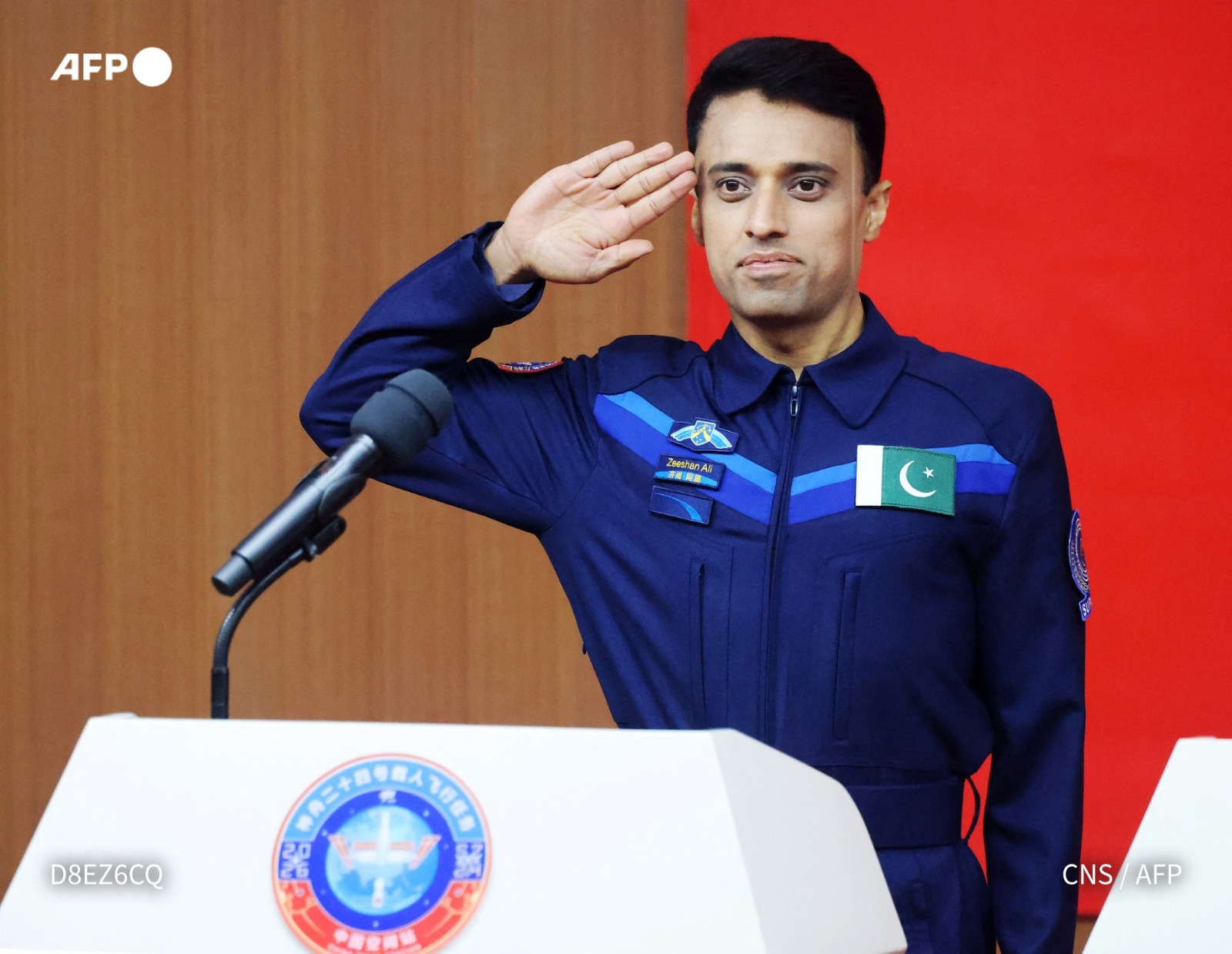
JIUQUAN, China — Pakistan Air Force Wing Commander Muhammad Zeeshan Ali is poised to make history on Wednesday as the first foreign astronaut to fly on a Chinese space mission and the first non-Chinese national to board Beijing’s Tiangong space station.
Speaking to reporters on Tuesday ahead of his departure, the 40-year-old pilot underscored the national significance of the mission. “I want to assure you that I am not flying for myself. I carry the name of Pakistan on my shoulder, the hopes of 250 million Pakistanis,” Ali said during a pre-launch media briefing.
Ali will serve as a payload specialist aboard the Shenzhou-24 spacecraft alongside veteran Chinese mission commander Tang Hongbo, 51, and first-time space flyer Wu Yi, who will act as flight engineer. The crew is scheduled to lift off aboard a Long March-2F carrier rocket at 00:18 GMT (8:18 a.m. Beijing time / 5:18 a.m. Pakistan time) on Wednesday from the Jiuquan Satellite Launch Center in the Gobi Desert of northwest China.
According to the China Manned Space Agency (CMSA), the spacecraft will utilize a 3.5-hour fast automated rendezvous and docking procedure to connect with the front port of the space station’s Tianhe core module.
Unlike his Chinese crewmates, who are scheduled for a standard six-month rotation aboard the orbiting outpost, Ali will undertake a short-duration stay of roughly one week. His primary objective is to install, initiate, and verify four joint scientific experiments developed through cooperation between the CMSA and Pakistan’s Space and Upper Atmosphere Research Commission (SUPARCO). Once installed in microgravity, the experiments will continue running for six to 12 months. Ali is slated to return to Earth alongside departing Chinese astronauts Lai Ka-ying—Hong Kong’s first astronaut—and Zhang Zhiyuan, while current station commander Zhu Yangzhu remains in orbit to complete China’s first full-year spaceflight endurance test.
The landmark mission is the culmination of a bilateral space agreement signed in Islamabad in February 2025. Ali and fellow Pakistani candidate Khurram Daud were selected in April 2026 to undergo intensive preparation in China, including centrifuge tests, survival simulations, and emergency drills. Reflecting on the rigorous regimen, Ali noted that mastering Mandarin posed the steepest hurdle, as every switch, software interface, and voice announcement aboard the spacecraft is in Chinese.
”The two great nations of China and Pakistan have turned a pilot into an astronaut in a remarkably short span of time,” Ali remarked.
CMSA spokesperson Zhang Jingbo hailed the flight as a major milestone as Beijing and Islamabad celebrate 75 years of diplomatic relations, describing Pakistan as China’s “all-weather strategic cooperative partner”. Having been excluded from the U.S.-led International Space Station, Beijing has invested billions into developing Tiangong as a rival orbital laboratory and a hub for international partnerships.
Do you want to advertise with us?
Do you need publicity for a product, service, or event?
Contact us on WhatsApp +2348033617468, +234 816 612 1513, +234 703 010 7174
or Email: validviewnetwork@gmail.com
CLICK TO JOIN OUR WHATSAPP GROUP

For Islamabad, the flight marks a major leap in its expanding space ambitions. Following the launch of Pakistan’s iCube-Qamar lunar orbiter aboard China’s Chang’e-6 probe in 2024, SUPARCO is already preparing to send a Pakistani rover to the lunar south pole on China’s Chang’e-8 mission around 2028.
Looking beyond Wednesday’s launch, Ali expressed optimism about the broader scientific and medical benefits the partnership will bring back to Earth. “I believe what comes after this flight matters more than the flight itself,” he said. “This mission is not a finish line; it is a launchpad.”