

By Aiyepola Abayomi
ABUJA: After months of muddled meetings, court battles and claims of a crumbling opposition, the Wike backed faction of the Peoples Democratic Party has finally answered the question that has trailed it since the aftermath of the 25 February 2023 general election: does it have a presidential candidate at all?
The answer came on 1 August 2026, when the Independent National Electoral Commission (INEC), in line with the Electoral Act and its timetable for the 2027 general election, published the personal particulars of presidential candidates submitted by political parties. The list included Senator Sandy Ojang Onor as the Wike faction’s presidential candidate, alongside his running mate, Babangida Umar, effectively ending months of speculation over whether the faction would field a ticket at all.
The faction’s National Publicity Secretary, Jungudo Mohammed, described the publication as having “effectively laid to rest” what he called sustained misinformation aimed at convincing Nigerians that the party would not present a presidential candidate. With INEC’s publication now on public display, the faction insists its participation in the 2027 race is no longer in doubt.
A Party at War With Itself
To understand the significance of INEC’s publication, one must first understand the crisis that preceded it.
Following the PDP’s defeat in the 25 February 2023 presidential election, the party descended into one of the deepest internal crises in its history. Rival camps emerged, one loyal to the Minister of the Federal Capital Territory, Nyesom Wike, and another aligned with former Vice President Atiku Abubakar and the party’s opposing leadership.
The conflict escalated in November 2025, when the anti Wike leadership announced the expulsion of Wike, former Ekiti State Governor Ayodele Fayose, Senator Samuel Anyanwu and several others over alleged anti party activities. Wike’s camp rejected the expulsions, insisting those responsible lacked the legal authority to take such action.
Around the same period, rival conventions produced competing national executives, with Wike’s allies installing Abdulrahman Mohammed as acting national chairman while declaring the opposing convention in Ibadan illegal. The dispute quickly moved from party secretariats to the courts, where each faction claimed victory after successive rulings.
A major turning point came on 30 April 2026, when the Supreme Court nullified the rival Ibadan convention, a judgment that the Wike faction has consistently cited as affirming its legitimacy. Even so, rival groups continue to interpret the judgment differently, leaving the political dispute far from settled despite the legal milestone.
It became a case study in Nigerian political theatre: two chairmen, rival conventions and one party’s identity contested like a family inheritance without a clear will. As Shakespeare’s Cassius observed, “The fault, dear Brutus, is not in our stars, but in ourselves.” Few modern political sagas illustrate that truth more vividly than the PDP’s prolonged internal conflict.
From Screening to Certainty
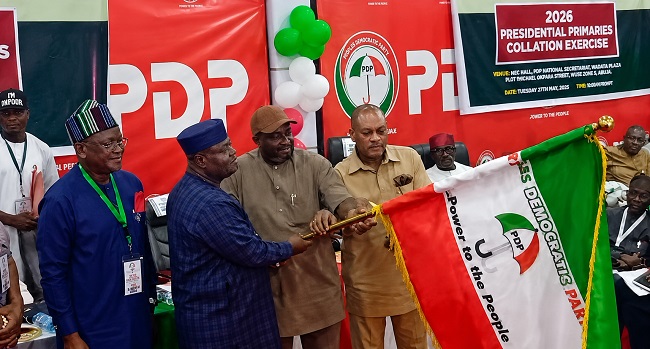
Onor’s path to the presidential ticket began on 15 May 2026, when he emerged as the sole presidential aspirant during the faction’s screening exercise at the PDP Legacy House in Abuja, alongside governorship aspirants from seventeen states.
Less than two weeks later, on 26 May 2026, former Benue State Governor Samuel Ortom, who chaired the Presidential Primary Collation Committee, formally announced Onor as the faction’s consensus presidential candidate after consultations and voice votes conducted across the states.
Officials of the Independent National Electoral Commission, including National Commissioners Abdullahi Zuru and Rhoda Gumus, monitored the exercise, providing official oversight of the primary process, although such monitoring does not amount to INEC’s endorsement of the outcome.

On 10 July 2026, the faction unveiled Babangida Umar as Onor’s running mate ahead of INEC’s nomination deadline. The presidential ticket was subsequently uploaded to the commission’s nomination portal before the 11 July 2026 deadline, and on 12 July 2026, the faction announced that all required nomination documents had been successfully submitted to INEC.
Accepting his nomination, Onor pledged to fly the PDP flag with “energy, courage and intellectual depth” while dismissing the growing influence of the African Democratic Congress, predicting that it would not stand the test of time. Whether that prediction proves correct remains to be seen, but for a faction that had spent nearly two years fighting for legitimacy, INEC’s publication represented much more than the emergence of a candidate. It marked official confirmation that the faction had successfully entered the 2027 presidential race.
Institutional Response and What It Signals
The Wike aligned leadership quickly portrayed the publication as vindication, not merely of Onor’s candidacy but of its broader claim to represent the authentic Peoples Democratic Party.
Do you want to advertise with us?
Do you need publicity for a product, service, or event?
Contact us on WhatsApp +2348033617468, +234 816 612 1513, +234 703 010 7174
or Email: validviewnetwork@gmail.com
CLICK TO JOIN OUR WHATSAPP GROUP
Political analysts, however, caution that administrative recognition of nomination documents should not be confused with political reconciliation. Rival PDP factions remain divided, while several governors continue to keep a cautious distance from Wike. Reports of ongoing consultations, including meetings involving Wike and PDP governors led by Oyo State Governor Seyi Makinde, suggest that the party’s internal disagreements remain unresolved despite the completion of the nomination process.
For a party that once produced four consecutive Nigerian presidents, the road to 2027 still runs through both the courtroom and the campaign trail. INEC’s publication may have answered questions about whether the Wike faction has a presidential candidate, but whether it can reunite the party behind that candidate remains a far more consequential contest, one that could shape the future of Nigeria’s opposition long before voters cast their ballots.