



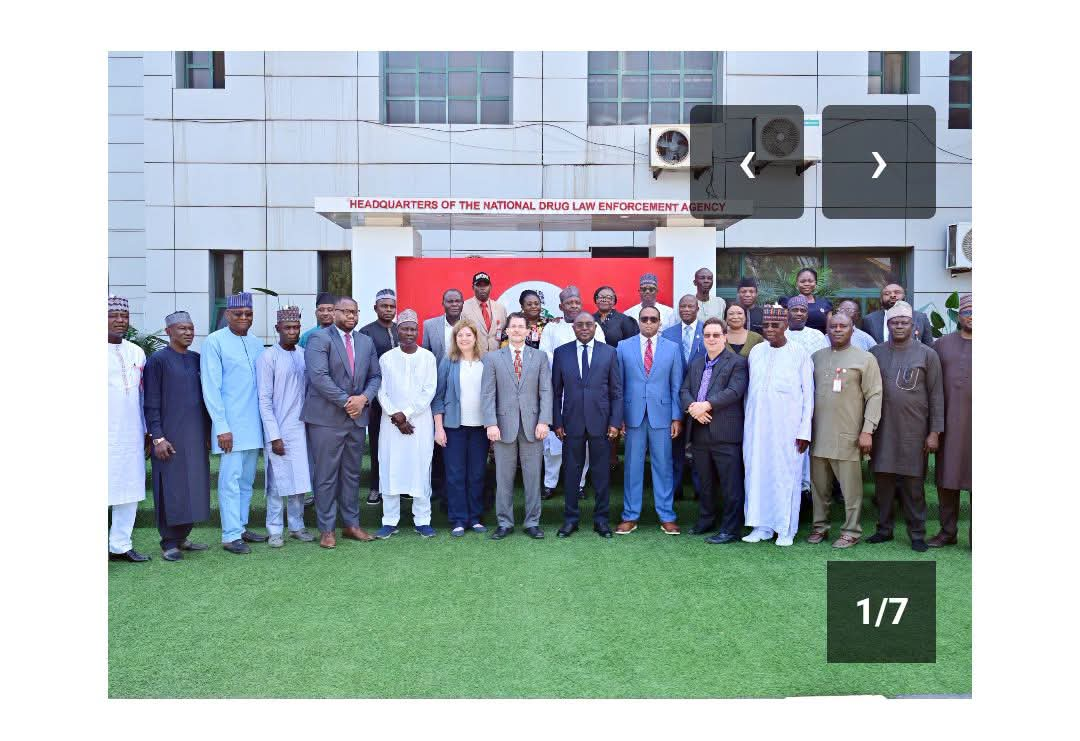
The United States has praised Nigeria’s National Drug Law Enforcement Agency for dismantling four industrial-scale methamphetamine laboratories linked to Mexican cartels this year, describing the operations as a model of intelligence-led enforcement that protects communities on both sides of the Atlantic.
Michael Gonzales, US Deputy Assistant Secretary of State for International Narcotics and Law Enforcement Affairs (INL) covering Africa and the Middle East, delivered the commendation on Tuesday during his first official visit to the NDLEA national headquarters in Abuja. He was received by the agency’s Chairman/CEO, Brig. Gen. Mohamed Buba Marwa (retd.), and members of the management team.
Gonzales, who assumed office four months ago, said Nigeria was the clear first choice for his travels. “As a leader, as an economic powerhouse on the continent, but also particularly NDLEA for the leadership and the impressive wins that you and your team and your interagency counterparts have delivered time and again,” he said. He added that he wanted to see “firsthand where the magic happens.”
He singled out the four meth lab busts recorded in 2026 as proof of best-practice tradecraft: intelligence-based investigations, coordination across agencies and borders, operational excellence, and thorough interrogation, investigation and prosecution. Narcotics, he noted, affect American communities more tangibly than almost any other foreign policy issue. The drug trade is international and largely unconstrained by borders, so the work of INL and the NDLEA “fundamentally delivers for the Nigerian people, for the American people.”
Gonzales pointed to more than 40 years of INL partnership with countries worldwide, which in Nigeria has taken the form of training and equipment support. He likened intense US pressure on cartels in the Western Hemisphere to “squeezing a balloon,” driving trafficking flows toward Africa and onward to Europe and Oceania. He also highlighted the shift from plant-based drugs to harder-to-detect, deadlier synthetics and called for sustained action against transnational criminal organisations as interconnected networks, including the money flows that sustain them.
Marwa welcomed the visit and framed the long-standing partnership—built through INL institutional assistance and cooperation with the US Drug Enforcement Administration—as a shared investment in the collective security of both nations. “Crime has no borders, and neither does the threat,” he said. “The drugs we seize, the arms we intercept and the terrorist financing we trace are not separate problems. When we seize narcotics and illicit weapons in the same operations and along the same routes, we are looking at the convergence of crime. Drug money buys guns, guns sustain armed groups, and armed groups sustain terrorism.”
He warned that what festers in the Sahel and the Lake Chad Basin does not stay there, and what is trafficked through West Africa does not stop at Nigeria’s coastline. On the Mexican cartel threat, Marwa was direct: “The Mexican cartel threat is real, and we are confronting it.”

In recent months, NDLEA operatives dismantled the largest clandestine methamphetamine laboratory ever discovered in Nigeria, hidden in a forest in Ijebu East, Ogun State. Three Mexican meth experts and their Nigerian collaborators were arrested on site, and illicit substances valued at more than $360 million were recovered. Barely four weeks later, the agency raided another industrial-scale laboratory at Tapa Village in neighbouring Oyo State, arresting a Mexican methamphetamine expert brought in for large-scale synthesis together with four Nigerian collaborators. Similar facilities linked to the same networks were subsequently dismantled in Enugu and Ebonyi States in the South-East.
“These were not isolated incidents. They show a deliberate attempt to turn Nigeria into a manufacturing hub,” Marwa said. The cartels, he added, are not setting up in Nigerian forests solely to supply local consumers. They want a West African corridor to ship industrial quantities of methamphetamine to Europe, Asia and American cities—especially as intensified US pressure (under what Marwa described as the “President Trump hammer”) squeezes traditional routes. Every laboratory shut down, he stressed, is a supply line that never reaches an American street, and every cartel operative arrested is one fewer in the pipeline. Nigeria’s forensic chemists, investigators and tactical teams are, in effect, providing forward defence for communities in the United States.
Marwa credited sustained INL support for strengthening the agency’s capabilities in forensic and chemical analysis, professional training, investigative and financial-crime skills, and equipment maintenance. Over the past five years, he said, that partnership has helped drive the arrest of 96,157 drug offenders (including 250 drug barons), the seizure of more than 15.8 million kilograms of assorted illicit drugs, and the conviction of 16,691 traffickers, including kingpins.
He warned that any withdrawal of INL support would create a gap that criminal networks and terrorist groups would quickly exploit. Traffickers, arms dealers and terrorists cooperate across borders every day; governments confronting them must do the same. Marwa asked Gonzales to carry a clear message to Washington: that INL support “as is, should be maintained if not increased.”
Do you want to advertise with us?
Do you need publicity for a product, service, or event?
Contact us on WhatsApp +2348033617468, +234 816 612 1513, +234 703 010 7174
or Email: validviewnetwork@gmail.com
CLICK TO JOIN OUR WHATSAPP GROUP
The visit underscores growing international recognition of NDLEA’s transformation under Marwa’s leadership into one of Africa’s most effective counter-narcotics agencies at a time when Mexican cartels are actively seeking alternative production and transit hubs amid tightened enforcement in the Americas.