



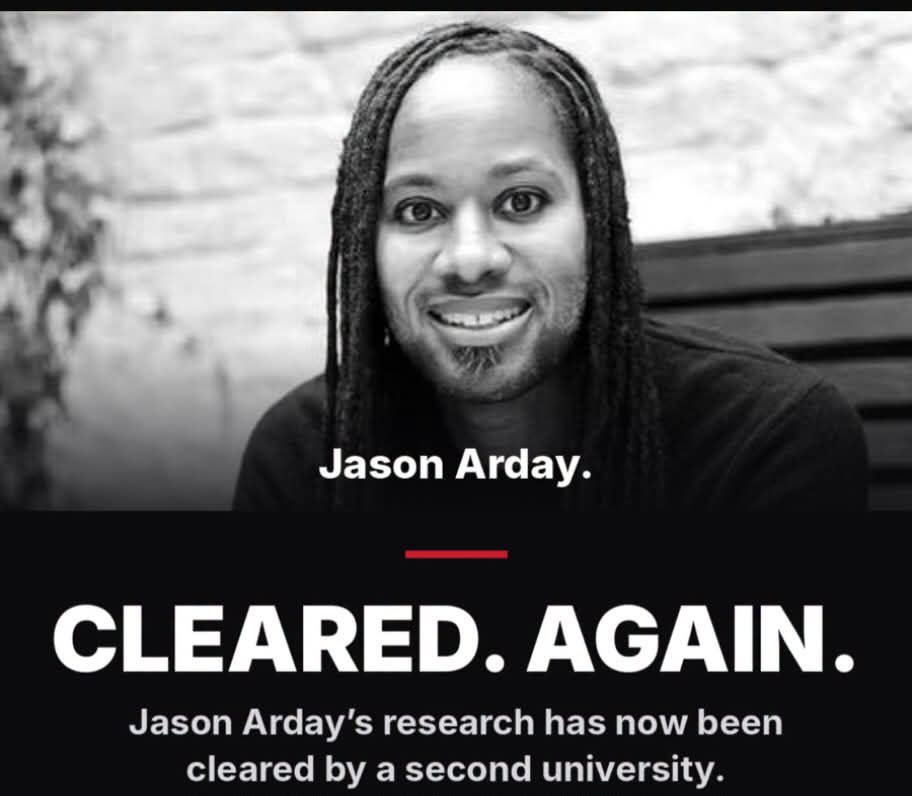
A second British higher education institution has officially cleared the late Professor Jason Arday of academic misconduct, confirming that a research paper he co-authored fully meets established scholarly standards.
In a formal statement issued on Thursday, November 26, 2026, Queen’s University Belfast (QUB) announced that an institutional review into a 2021 paper co-authored by the former University of Cambridge academic—titled “Attempting to Break the Chain: Reimagining Inclusive Pedagogy and Decolonising the Curriculum Within the Academy”—found no grounds for concern.
”After reviewing the matter, the university is satisfied the paper meets appropriate academic standards and holds no concerns regarding its publication,” a Queen’s University Belfast spokesperson confirmed to journalists.
The ruling marks the second major posthumous vindication for Arday, who died at his south London home on August 14, 2026, at the age of 41. Prior to QUB’s announcement, Liverpool John Moores University, which awarded Arday his doctorate, had independently reviewed his work and concluded that he had not committed plagiarism.

Appointed in 2023 as Professor of Sociology of Education at the University of Cambridge, Arday made history as the youngest Black professor ever appointed at the prestigious institution. However, in early August 2026, his career was engulfed by intense, immediate media and institutional scrutiny following public allegations of plagiarism and questions surrounding his academic credentials.
Arday consistently denied all allegations of wrongdoing. Nonetheless, on August 7, 2026—the very day he announced his resignation from Cambridge—the university publicly declared that it had launched a formal investigation into his academic qualifications and appointments. He was found unresponsive at his London residence just days later, prompting a coroner’s inquest and widespread grief across the British academic community.
The latest clearance has reignited fierce debate in the United Kingdom over institutional double standards, racial bias, and the selective urgency with which universities and sections of the British press police alleged misconduct.
Writing in The Independent following Arday’s death, Dr. Charlotte Proudman, an award-winning barrister and senior research associate at Jesus College, Cambridge, highlighted the stark contrast between the public spectacle surrounding Arday and how elite institutions routinely handle serious misconduct complaints against established insiders.
Critics and commentators have pointed to a well-documented case at a Cambridge college in which a senior academic faced formal complaints of sexual harassment from ten women. Rather than facing immediate public expulsion or relentless media pillorying, the academic issued an apology and subsequently had his college dining rights restored.
Advocates for institutional reform argue that the disparity exposes how universities decide whose alleged infractions constitute an urgent public emergency and whose are quietly managed behind closed doors. While women who report powerful men are frequently urged toward discretion and confidentiality, a trailblazing Black scholar faced career-ending scrutiny in full public view over allegations that two separate universities have now decisively rejected.
As commentators have noted, the issue is not a competition between different forms of harm, but rather the operation of a single institutional culture—one that instinctively shields those who fit the traditional academic mould while subjecting outsiders to relentless public policing.
Do you want to advertise with us?
Do you need publicity for a product, service, or event?
Contact us on WhatsApp +2348033617468, +234 816 612 1513, +234 703 010 7174
or Email: validviewnetwork@gmail.com
CLICK TO JOIN OUR WHATSAPP GROUP
In the wake of Arday’s death, the University of Cambridge has commissioned a two-part independent review—led by a prominent inquiry barrister—to examine both the pastoral support available to Arday before his passing and the broader institutional circumstances surrounding his tenure. Meanwhile, the academic whose public accusations sparked the controversy was suspended by Ghent University and handed a three-month teaching ban following an investigation into discriminatory conduct.