



Lagos — Members of the LoveWorld Ministry of Information have intensified their campaign against what they describe as the sexualisation of Nigerian schoolchildren through Comprehensive Sexuality Education (CSE) and related materials, announcing plans to develop an alternative, values-based curriculum with the help of more than 400 child advocates worldwide.
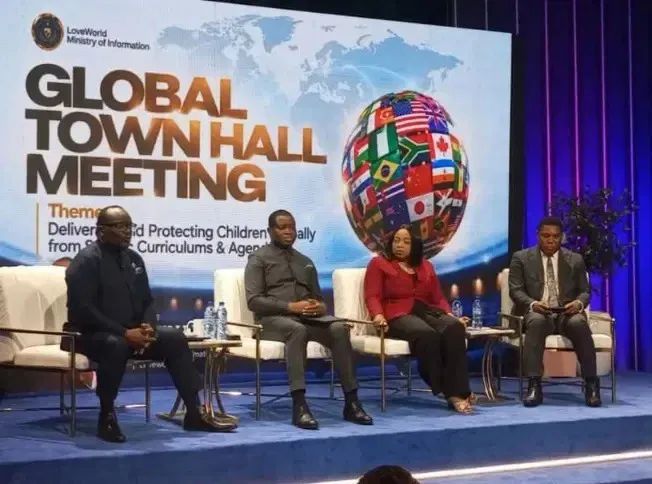
The group raised the alarm at a Global Town Hall Meeting organised by the LoveWorld Ministry of Information in Lagos. Themed “Delivering and Protecting Children Globally from Satanic Curriculums & Agenda,” the gathering brought together legal practitioners, policy experts, child advocates and ministry representatives to discuss parental rights, curriculum content, international influence and digital exposure.
Speakers alleged that LGBTQ-related topics and other sensitive materials are finding their way into classrooms under the umbrella of CSE and Family Life and HIV Education (FLHE). They urged parents to scrutinise textbooks and teaching materials more closely and to demand accountability from education authorities.
Legal adviser to the Center for African Policy Research and Advisory (CAFPRA), Sonnie Ekwowusi, claimed that some secondary school materials address homosexuality, lesbianism, masturbation, sterilisation, breast enlargement and sexual orientation. “Today, we have talked about the danger in teaching Comprehensive Sexuality Education in Nigeria’s secondary schools. We have highlighted the fact that topics such as masturbation, sterilisation, breast enlargement, homosexuality and lesbianism are being taught to boys and girls in Nigerian schools,” he said.
Ekwowusi described the content as a “taboo” and called on parents to organise and insist that such materials be withdrawn. He identified the Nigerian Educational Research and Development Council (NERDC) as the body responsible for curriculum development and urged parents to channel complaints there. He has previously characterised CSE as “anti-Africa, anti-culture, anti-common sense,” arguing that it undermines traditional values and is driven by foreign agendas.
Dr Segun Adebayo, Executive Director of CAFPRA, highlighted the practical challenges many parents face. Long working hours, he said, leave little time to review children’s books, effectively outsourcing their moral and educational formation. “You would find out that somebody else is training your children. These people are not Nigerians. They are people who don’t believe what you believe. They don’t accept your values, and they rather want to change your values,” he warned. Adebayo advocated stronger public awareness and greater parental involvement in education policy, pointing to a proposed African Charter on Family Values and Sovereignty as a possible protective framework.
LoveWorld’s Executive Minister of Education, Dr Afolabi Oketunji, said the organisation is already developing its own curriculum and materials with a “Christ-centred approach.” “We have to redefine. They introduced it; we will introduce the right curriculum,” he declared. The ministry plans to work with teachers, re-orient educators, produce textbooks through its publishing arm, and make curriculum content transparent to parents. The effort is intended to reach beyond LoveWorld schools to the wider education system.
International voices at the meeting reinforced the call for parental primacy. Sharon Slater, President of Family Watch International (which holds consultative status with the United Nations), stressed that parents are the first and most important educators of their children. She questioned the role of international donor funding in shaping African education and health policies. Her husband, international law expert Greg Slater, argued that no international treaty or legal obligation requires countries to introduce CSE in schools. “Parents need to be vigilant. They need to ask questions, find out what is being taught in schools and examine the materials being used to teach their children,” he advised.

Richard Kakeeto of the African Bar Association Governing Council distinguished between binding international treaties and non-binding “soft law” policy recommendations, urging African nations to ensure educational policies align with their constitutions and cultural realities.
Christine Okechukwu, LoveWorld’s Executive Minister of Children’s Affairs, announced plans for a Global Parents Forum and the training of child advocates. The ministry also intends to produce music, animation, games and other positive digital content as alternatives to what it sees as harmful online material. Mrs Jessie Kalu of the Kiddies Media Ministry, represented by Pastor Tayo Tubo, warned that the battle for children’s minds now extends far beyond the classroom into digital platforms. “Our children are consuming content every day, so we must intentionally give them the right content,” he said.
Background and Context
Nigeria’s official school-based programme is Family Life and HIV Education (FLHE), introduced in the early 2000s in response to high rates of HIV and other sexually transmitted infections among young people. Developed by the NERDC in consultation with stakeholders, FLHE covers human development, personal skills, relationships, HIV prevention and society and culture. It was deliberately diluted from a more explicit Comprehensive Sexuality Education model after strong resistance from religious and conservative groups, and is intended to emphasise abstinence and life skills while being adapted to local values.
Implementation has varied across states, and critics have long alleged that certain textbooks and supplementary materials go further than intended, introducing topics they consider age-inappropriate. CAFPRA and other groups have recently pressed the National Assembly to review related policies, funding sources and international partnerships. NERDC, for its part, continues to oversee curriculum development and textbook quality, recently disclaiming unauthorised funding appeals and tightening ranking standards for instructional materials.
LoveWorld said it will expand engagement with government institutions, parents, teachers and other stakeholders while rolling out its alternative materials and digital content. The organisation framed the effort as a defence of children’s innocence and African family values against what it regards as external ideological pressure.
Do you want to advertise with us?
Do you need publicity for a product, service, or event?
Contact us on WhatsApp +2348033617468, +234 816 612 1513, +234 703 010 7174
or Email: validviewnetwork@gmail.com
CLICK TO JOIN OUR WHATSAPP GROUP