

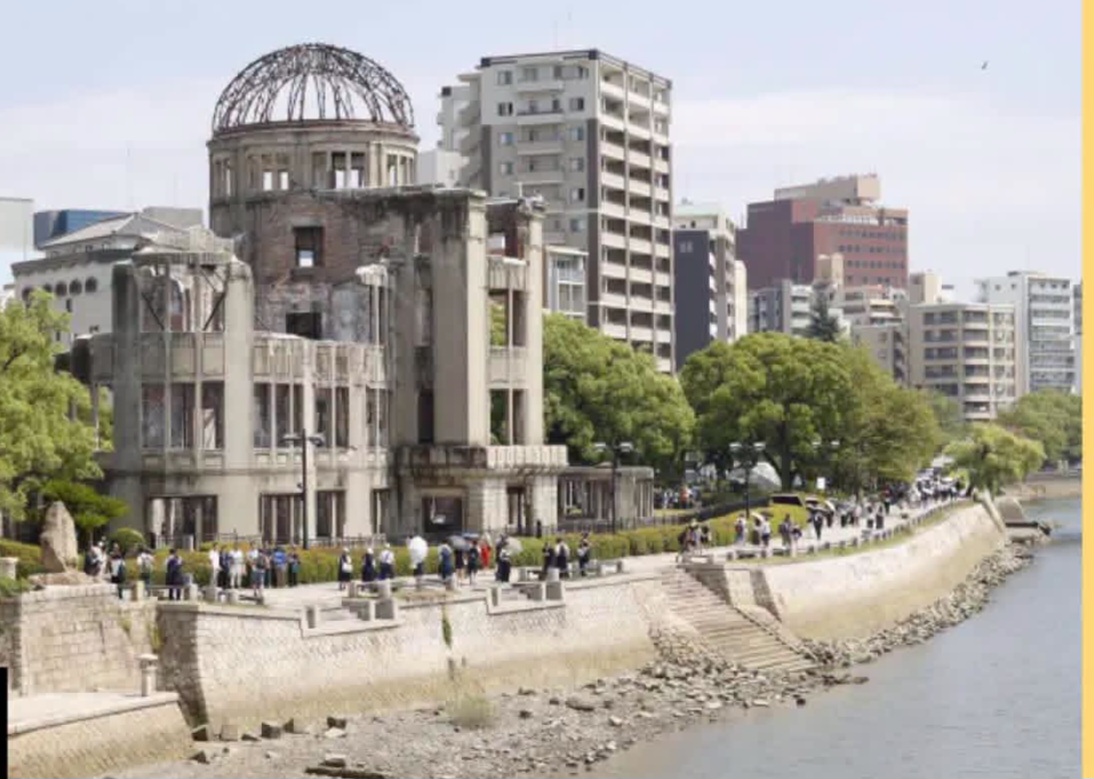
Nearly eighty years after the atomic bomb devastated Hiroshima, scientists have uncovered a secret left behind in the wreckage: a previously unknown metallic alloy forged in the searing heat of the 1945 blast.
The microscopic material was discovered inside tiny, glassy radioactive fallout particles—known as hiroshimaites—collected from the beach sands of Hiroshima Bay. Researchers from the University of Florence, led by geologist and crystallographer Luca Bindi, published the findings in the journal Science Advances, revealing how the catastrophic event acted as an accidental materials science laboratory.
Forged in a Nuclear Fireball
When the “Little Boy” atomic bomb detonated 1,900 feet above the city at 8:15 a.m. on August 6, 1945, it created a turbulent plasma cloud. Temperatures inside the fireball soared past 7,000°C, instantly vaporizing buildings, infrastructure, soil, and steel structures.
As this chaotic cloud of vaporized elements expanded, it cooled within fractions of a second. This extreme process—known as rapid quenching—trapped atoms into unique structural phases that cannot be replicated under normal terrestrial conditions.
While examining 34 hiroshimaite samples using advanced electron microscopy and single-crystal X-ray diffraction, the research team isolated a metallic grain measuring roughly 10 micrometers across—only a fraction of the width of a human hair.
A Unique Crystalline Structure
The grain consisted of a silicon-rich, multicomponent alloy combining iron, chromium, nickel, manganese, molybdenum, and aluminum. While these components are common ingredients in industrial stainless steel and structural metals, their atomic arrangement matched no known substance on Earth.

Rather than settling into a standard disordered lattice, the atoms locked into a highly organized, complex crystalline framework. The discovery mirrors similar recent findings by the same research team at the site of the Manhattan Project’s Trinity test, reinforcing the idea that extreme anthropogenic events can create entirely new classes of matter.
Do you want to advertise with us?
Do you need publicity for a product, service, or event?
Contact us on WhatsApp +2348033617468, +234 816 612 1513, +234 703 010 7174
or Email: validviewnetwork@gmail.com
CLICK TO JOIN OUR WHATSAPP GROUP
Scientists believe that cataloging these rare materials can significantly enhance nuclear forensics, helping researchers better understand the markers of high-energy blasts. Furthermore, analyzing how these complex structures form under severe thermal gradients could inspire new manufacturing methods for advanced heat-resistant and corrosion-proof alloys—without the catastrophic conditions required to initially discover them.