



There are some news stories I wish I never had to read. Sadly, they keep coming.
Just a few moments ago, I read another heartbreaking report about the death of another young man with a bright future ahead of him, and I am broken. It is becoming painfully familiar. Every time I come across such stories, I cannot help but imagine the dreams that have suddenly ended, the parents whose worlds have collapsed, the siblings whose lives will never remain the same, and the friends who will forever ask, “Why?”
One thing I have quietly observed over the years is that many of these young people spent the earlier parts of their lives in Nigeria or other African countries before the family relocated abroad in search of education, opportunities, or a better future.
What particularly moved me today were the touching tributes showered on a young Nigerian of Yoruba extraction who tragically lost his life while swimming. Reading the heartfelt messages from friends, classmates, and loved ones left me with a heavy heart. I could not imagine the pain in the heart of the parents!
As I reflected on similar tragedies, I discovered a disturbing pattern. A significant number of these deaths among young Africans abroad occur during swimming incidents.
Why?
I believe several factors may be responsible.
One major factor is that many of these young men grew up in environments where swimming was never part of childhood. In Nigeria and many other African countries, parents deliberately kept their children away from rivers, streams, lakes, and even swimming pools because of genuine safety concerns. Swimming was simply not considered a normal childhood activity except in riverine areas.
Ironically, we also hear of young people drowning in rivers and swimming pools within Nigeria itself. This confirms that water is dangerous everywhere. It does not matter whether the water is in Africa, Europe, America, or anywhere else. Water obeys no nationality.
I strongly believe everyone should know how to swim because it is a lifesaving skill that could mean the difference between life and death. However, I equally believe that nobody should step into deep water without proper training. Knowing a few strokes is not the same as knowing how to survive in changing water conditions.
This conviction comes from personal experience.
In my younger days, my siblings and I once went swimming in a river. What started as fun quickly turned into terror as the current almost swept us away. Looking back today, I can only say it was by the mercy of God that we survived. That experience has stayed with me for life. I echoed this into the mind of my children as soon as they could hear.
Growing up in Nigeria and in many other African countries, almost every boy plays football. Whether he is good at it or not is another issue entirely. Football is almost compulsory in our upbringing. In some other parts of the world, swimming occupies a similar place in their culture. Children are introduced to it early and receive proper lessons. They grow up understanding not just how to swim but also how to respect water.
I have also noticed another painful trend. Most of the drowning victims among Nigerians and Africans appear to be young men rather than young women. This makes me wonder whether the desire to impress friends sometimes plays a role.
An average young man may find it difficult to admit, “I cannot swim.” Pride whispers that he can manage, that he will figure it out, that he should not appear weak before his peers.
Unfortunately, water is not something anyone can negotiate with.
It is never an issue to trivialise.
It is a matter of life and death.
Nothing should make anyone take unnecessary risks around water.
I know many African parents abroad repeatedly warn their children about rivers, lakes, beaches, and swimming pools. Sadly, when these children find themselves in new environments, surrounded by friends who seem comfortable in the water, those warnings suddenly appear to them as typical African parenting, overprotective and old fashioned.
Then comes the temptation to cross the red line.
They forget the monumental and unimaginable pain one careless decision can inflict upon an entire family.
Trying to prove that you can do what you cannot do is not bravery.
It is not smartness.
It is a deliberate exposure to danger and an open invitation to calamity.
Do you want to advertise with us?
Do you need publicity for a product, service, or event?
Contact us on WhatsApp +2348033617468, +234 816 612 1513, +234 703 010 7174
or Email: validviewnetwork@gmail.com
CLICK TO JOIN OUR WHATSAPP GROUP
Someone who has gone through the rudiments of swimming understands what to do when the rhythm of the water suddenly changes, when exhaustion sets in, when panic begins, or when currents become unpredictable. The amateur, however, assumes swimming is simply moving the hands and legs until it is too late.
That is why supervised swimming is always better. If anyone must swim, let it be under proper supervision and after receiving adequate training.
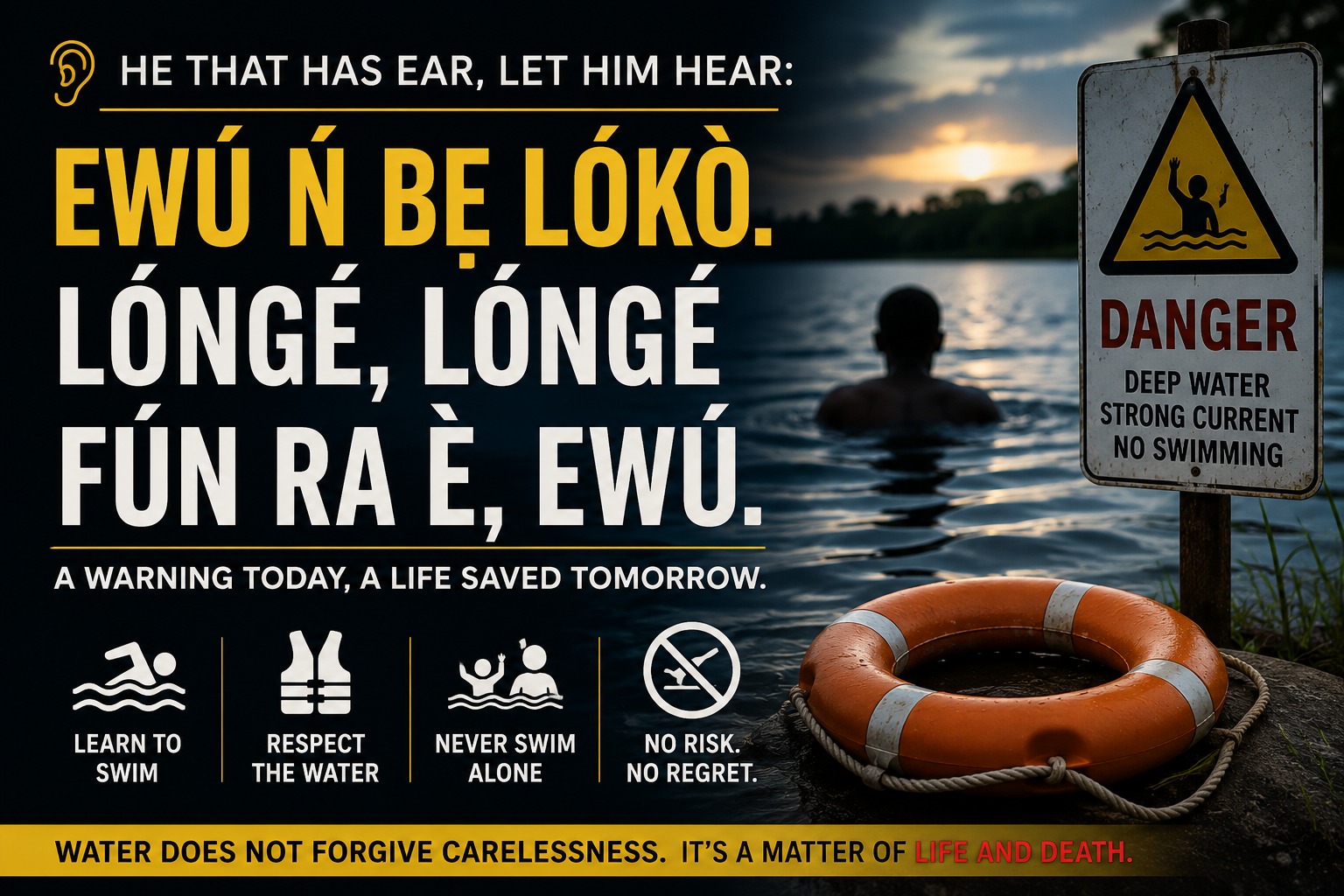
This reminds me of a Yoruba expression : Ewu ńbę lóko Lóngé, Lóngé fún ra è, ewu.
In simple terms, it is a warning that danger truly exists. It is not imaginary. It is real, even if it appears distant or harmless. A person who ignores repeated warnings because everything seems peaceful may suddenly find himself overwhelmed by the very danger he dismissed.
An amateur walking confidently into a lake to swim is much like the person who hears repeated warnings about danger but convinces himself that nothing will happen. Unfortunately, water has no respect for overconfidence.
The saddest part is that young people may never fully understand the lifelong pain their parents carry after losing a child in such circumstances.
The funeral may be over.
Friends may gradually move on.
Life may continue.
But for the parents, every birthday becomes a reminder.
Every family gathering carries an empty seat.
Every achievement of another child reminds them of what might have been.
The memory lingers for years. Perhaps forever.
As a society, we must do more.
Swimming education should be encouraged from an early age. Young people should never allow peer pressure to override common sense.
Schools, universities, churches, community organisations, and African associations abroad should organise water safety awareness programmes.
Parents should continue having honest conversations with their children about hidden dangers.
Friends should never mock someone who admits, “I cannot swim.”
Instead, encourage them to learn safely.
This warning is not limited to swimming alone. It is equally dangerous for a young man to jump into a car driven by a drunk friend or by someone who lacks the competence to drive. The desire to belong should never become more important than the desire to stay alive. Life is precious.
There is only a thin line between life and death.

Let us never cross that line carelessly.
Finally, my heart goes out to every parent who has buried a child after such a tragedy. There are no words sufficient to describe your pain. No parent should ever have to answer a knock on the door or a phone call announcing that a son or daughter who left home full of life will never return.
May the God of all comfort remain with every grieving family.
May He strengthen the hearts of fathers and mothers whose tears no one can truly measure.
May He grant them peace that surpasses human understanding.
And may He protect our children wherever they are in the world, giving them the wisdom to choose safety over pride, caution over pressure, and life over unnecessary risk.
Amen.
Kayode Ogunjobi, FHEA, FFAN, is an environmental researcher, public affairs analyst, and passionate advocate for nature conservation, with a strong interest in environmental sustainability, ecological safety, and responsible public policy.