



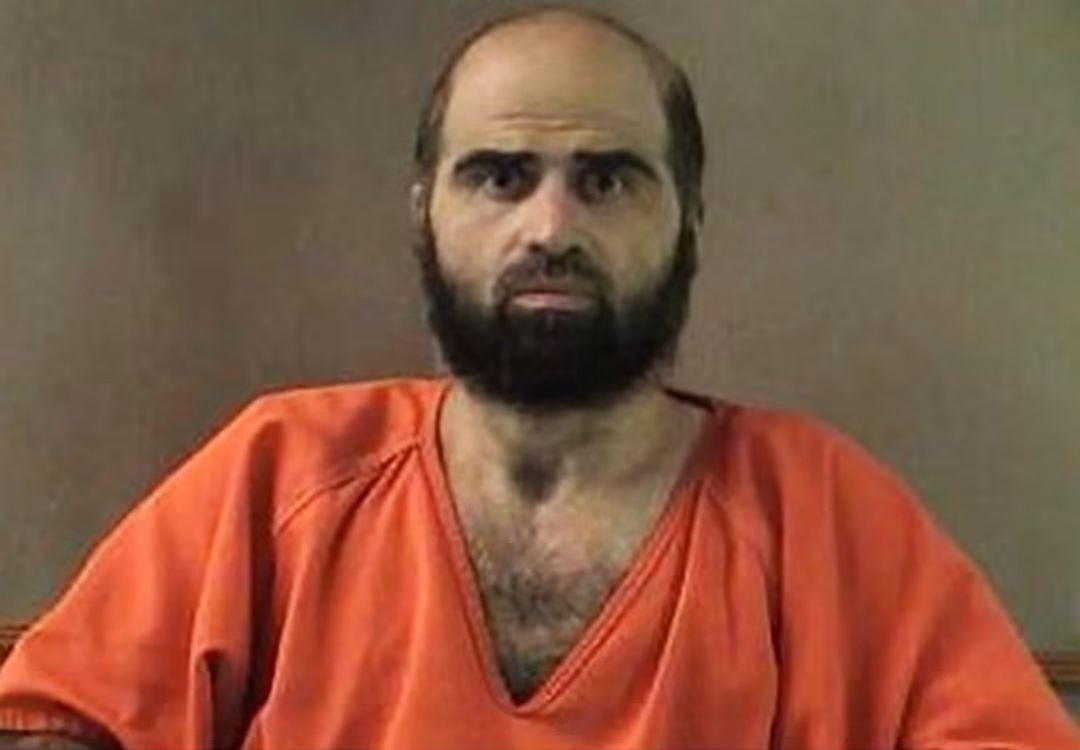
Convicted Fort Hood gunman Nidal Malik Hasan has launched an urgent eleventh-hour legal bid to halt his scheduled December 3 execution by firing squad, arguing that his constitutional rights were violated when military judges barred him from claiming his 2009 mass shooting was “legally justifiable.”
In a motion filed on Tuesday in the U.S. District Court in Kansas—where Hasan is incarcerated on military death row at the U.S. Disciplinary Barracks in Fort Leavenworth—the former U.S. Army major and psychiatrist requested a stay of execution. The delay would allow him time to file a federal habeas corpus petition challenging his 2013 court-martial conviction and death sentence. U.S. District Judge Tony Mattivi, a Trump appointee, has been assigned to preside over the case, with an initial hearing set for Wednesday afternoon.
Central to Hasan’s filing is his contention that the military court unlawfully stripped him of his chosen defense during his 2013 trial. Hasan claims his deadly rampage was a “defense of others,” asserting he acted to protect the Afghan Taliban and fellow Muslims from an “unlawful attack” by U.S. forces deploying to Afghanistan. After the trial judge precluded him from presenting that argument, Hasan—who represented himself—remained largely silent, calling no witnesses and offering no closing statement after the military presented roughly 90 witnesses over an 11-day proceeding.
Beyond trial errors, Hasan’s court filing also alleges “unlawful command influence,” accusing President Donald Trump and Defense Secretary Pete Hegseth of interfering in his case out of racial and religious bias against him as an Arab American Muslim of Palestinian descent.
While Hasan continues to act as his own attorney, lawyers from the American Civil Liberties Union (ACLU) and the ACLU of Kansas have entered the case as standby counsel to back his bid for a stay.

”There is no question that the violence committed at Fort Hood caused unimaginable pain and loss,” said Anna Arceneaux, deputy director of the ACLU’s Capital Punishment Project. “But the gravity of that loss does not change the government’s obligation to uphold the principles that define our justice system. Mr. Hasan, like every person facing an irreversible punishment, must have a chance to pursue federal review of his case.”
The Pentagon declined to comment on the pending litigation.
The legal showdown comes just over a week before the U.S. Army is set to carry out its first military execution in more than six decades. Following the U.S. Supreme Court’s March 2025 denial of Hasan’s final direct appeal, President Trump formally approved the death sentence on October 2, 2026. Days later, Acting Secretary of the Army Adam Telle scheduled the firing squad execution for 1 p.m. CST on December 3 at Fort Hood, Texas—the exact base where the tragedy unfolded.
The lead-up to the execution has already been marked by intense public controversy and emotional fallout for survivors. Last month, Defense Secretary Hegseth and Pentagon officials sparked widespread outrage from victims’ families, lawmakers, and military religious leaders after announcing plans to livestream the firing squad. President Trump subsequently scrapped the broadcast plan following the backlash.
Meanwhile, several survivors wounded in the 2009 attack have expressed frustration after the Army denied their requests to witness the execution in person. Citing military execution regulations, officials ruled on November 10 that the three survivors—including Julia Wilson, who was nine months pregnant when she was shot—were ineligible to attend because they were not listed as direct victims on the specific capital murder counts.
Religious leaders and anti-death penalty advocates have also criticized the administration’s handling of the warrant. The Reverend Jeff Hood, a spiritual adviser who has attended over a dozen executions, accused the administration of turning the punishment into a “political production.”
”Yet anyone familiar with the federal death penalty process understood that a habeas corpus petition could bring the entire timetable to a halt,” Hood said. “The administration has discovered that executions are not campaign rallies, and that the machinery of government cannot simply be commanded to produce a death on a political schedule.”
On November 5, 2009, Hasan entered a Soldier Readiness Processing Center at Fort Hood, shouted “Allahu akbar,” and opened fire on troops preparing for deployment, killing 12 soldiers, one civilian, and an unborn child, while wounding 32 others. Paralyzed from the waist down after being shot by responding military police officers, Hasan was convicted on 13 counts of premeditated murder and 32 counts of attempted murder in August 2013.
If Judge Mattivi denies the stay and the execution proceeds next week, Hasan will be the first U.S. service member put to death since Army Private John Bennett was hanged in April 1961, and the first executed by a military firing squad since World War II.
Do you want to advertise with us?
Do you need publicity for a product, service, or event?
Contact us on WhatsApp +2348033617468, +234 816 612 1513, +234 703 010 7174
or Email: validviewnetwork@gmail.com
CLICK TO JOIN OUR WHATSAPP GROUP