



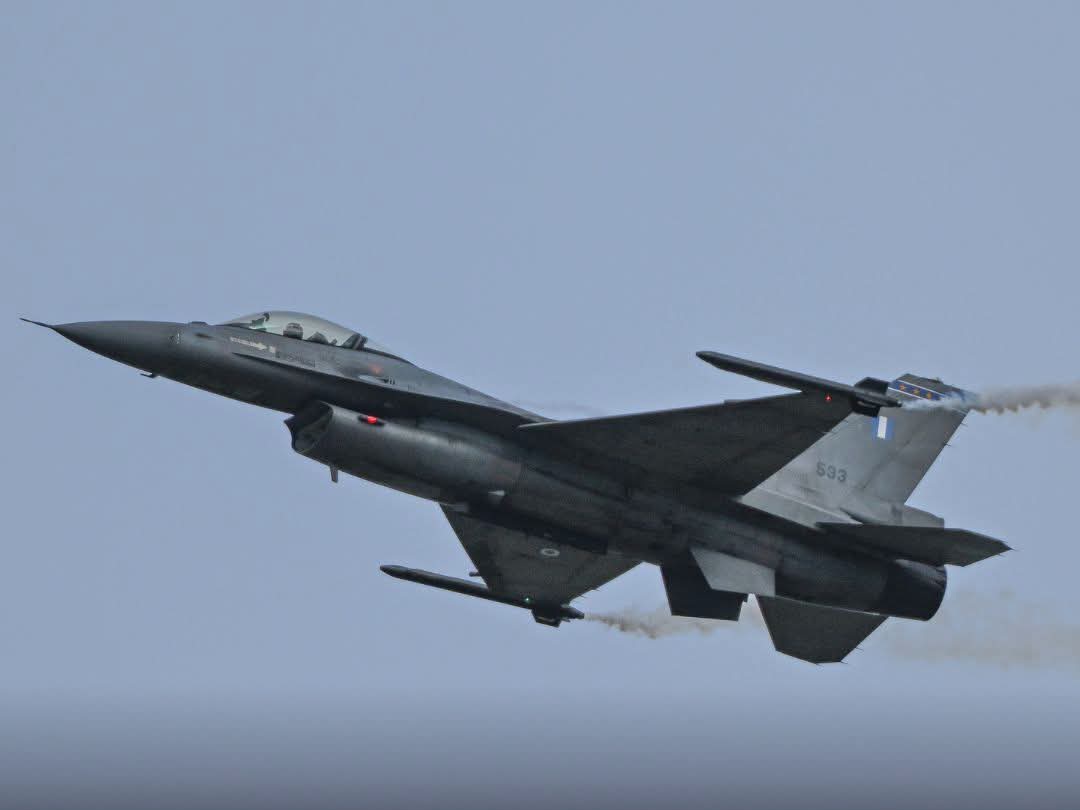
WARSAW, Poland — A Swedish fighter pilot operating under NATO command came moments away from shooting down a Russian cruise missile over Polish territory last week, holding fire only because severe weather obscured visual identification, military officials confirmed.
The near-engagement marks a dramatic escalation along NATO’s eastern flank following two separate Russian violations of Polish airspace within four days—prompting Warsaw to demand stronger allied air defenses and renew its urgent push for a permanent United States military presence.
A Brush with Direct Engagement
The first and most volatile incursion occurred on Nov. 20 during a massive overnight Russian aerial barrage against western Ukraine. According to Lt. Gen. Ireneusz Nowak, commander of Poland’s Armed Forces Operational Command, allied radar tracked 11 potentially threatening aerial objects near the border, three of which crossed directly into Polish airspace.
NATO’s Combined Air Operations Centre in Uedem, Germany, scrambled allied aircraft—including Polish F-16s, a Swedish Saab 340 early warning plane, a Dutch aerial refueling tanker, and Swedish JAS 39 Gripen fighter jets—and issued conditional authorization for a Swedish Gripen pilot to engage one of the incoming targets. However, thick cloud cover and poor visibility prevented the pilot from positively identifying the projectile either visually or via onboard electro-optical sensors. Following strict rules of engagement to avoid misidentification, the pilot stood down.
Polish prosecutors later confirmed that debris recovered from three crash sites in southeastern Poland—near Nowy Lipowiec, Rudnik nad Sanem, and Młodów—belonged to Russian Kh-101 air-launched cruise missiles. Preliminary forensic analysis indicated the missiles had rolled off the assembly line at a facility in Dubna, near Moscow, as recently as October or November of this year.
A Second Breach in Four Days
Before allied diplomats could finish assessing the missile strikes, Moscow tested Poland’s borders again. Overnight on Nov. 24, a jet-powered Russian unmanned aerial vehicle penetrated roughly 20 kilometers into Polish airspace from Ukraine, remaining inside NATO territory for approximately nine minutes.
Polish air defense forces tracked the drone continuously and received clearance to shoot it down. Commanders ultimately held fire due to the risk of falling debris harming civilians on the ground, and the drone eventually turned back east toward Ukraine.
‘An Intentional Provocation’
Polish leaders have rejected any suggestion that the back-to-back violations were navigational errors. Polish Prime Minister Donald Tusk and Deputy Defense Minister Paweł Zalewski both characterized the breaches as an “intentional provocation,” noting that the Nov. 20 missile strike occurred dangerously close to southeastern Poland, where British, French, and other European troops were conducting joint military exercises.
”It’s hard to imagine this being a coincidence, so we assume it was an intentional act,” Zalewski told Polish broadcaster RMF FM.
The incidents also spotlighted a growing transatlantic friction over how to interpret Kremlin aggression. Just hours before the Nov. 20 missile breach, U.S. President Donald Trump downplayed previous Russian incursions while speaking to reporters aboard Air Force One, suggesting Moscow had landed drones and “a couple of little missiles” in Poland “by mistake”—a characterization sharply rebuked by European leaders.
Warsaw Pushes for Permanent U.S. Troops and Forward Interceptions

In response to the twin breaches, Warsaw has launched an aggressive diplomatic and military offensive in both Washington and Brussels.
Bogdan Klich, Poland’s chargé d’affaires in Washington, confirmed that he briefed the White House National Security Council on the Kh-101 missile incursions and formally renewed Warsaw’s long-standing request for a permanent deployment of U.S. troops on Polish soil. Roughly 7,000 to 10,000 American personnel are currently stationed in Poland on a rotational basis, a posture Polish officials argue is no longer sufficient to deter Moscow.
Simultaneously, following an emergency meeting of the North Atlantic Council in Brussels on Nov. 23, NATO Secretary-General Mark Rutte pledged that the alliance would “defend every inch of Polish territory”. Supreme Allied Commander Europe Gen. Alexus Grynkewich immediately authorized the forward deployment of an Airborne Warning and Control System (AWACS) surveillance aircraft to Poland to bolster radar coverage.
Do you want to advertise with us?
Do you need publicity for a product, service, or event?
Contact us on WhatsApp +2348033617468, +234 816 612 1513, +234 703 010 7174
or Email: validviewnetwork@gmail.com
CLICK TO JOIN OUR WHATSAPP GROUP
However, Warsaw is pushing NATO to go even further. According to diplomatic reports from Brussels, Polish representatives have formally proposed that allied air defenses be authorized to intercept Russian missiles and drones while they are still over Ukrainian territory—before they can cross into NATO airspace and endanger European civilians. While alliance leaders weigh the escalation risks of intercepting targets outside NATO borders, military analysts warn that the margin for error between Moscow and the Western alliance has rarely been thinner.