



The Vice-Chancellor of the Nigeria Maritime University (NMU), Okerenkoko, Prof. Flora Tobolayefa Oluwafemi, has urged governments to invest nationwide in community-owned solar drying centres, enforce stricter food safety standards and improve postharvest handling, to cut food spoilage, agricultural losses and risks to public health.
Prof. Oluwafemi, a Microbiology and Food Safety scholar at the Federal University of Agriculture, Abeokuta (FUNAAB), made the call on Wednesday, November 18, 2026.
She was delivering FUNAAB’s 118th Inaugural Lecture, titled “Food Spoilage Mitigation Strategies as Race Against Time”, ValidViewNetwork reports.
She named poor postharvest handling, inadequate preservation infrastructure and weak food safety practices as the main threats to food quality, public health and national food security.
SOLAR DRYING CENTRES FOR FARMERS
According to ValidViewNetwork’s findings, she asked governments at all levels to build community-owned solar drying centres in major grain- and root-crop-producing areas.
Farmers and processors could then lower the moisture content of produce immediately after harvest. That limits fungal growth and the formation of aflatoxins and other harmful mycotoxins.
She added that the centres would especially empower smallholder farmers and women processors. They would also raise produce quality and market value, and strengthen rural development and climate resilience.
STRICTER STANDARDS AND ENFORCEMENT
The Founding Vice-President of the Nigeria Mycotoxin Awareness and Study Group also called for national hygiene standards for small-scale food production.
She said the standards must be enforced and backed by practical training for local processors, with clear guidelines on water quality, packaging and environmental sanitation.
She also asked for more institutional support for the National Agency for Food and Drug Administration and Control (NAFDAC) and the Standards Organisation of Nigeria (SON).

With it, both agencies could inspect cottage-level food processing more thoroughly, reduce contamination and improve market acceptance of locally processed foods.
INDUSTRY AND RAPID TESTING
ValidViewNetwork gathered that Prof. Oluwafemi also challenged cereal processors, dairy producers and snack manufacturers to explore probiotic cultures and natural antimicrobial agents in their products.
In her view, this would improve food safety, reduce spoilage after processing and meet growing consumer demand for foods with fewer artificial additives.
She further advocated affordable, portable rapid-testing technologies. These would detect aflatoxins, other mycotoxins, spoilage bacteria, moisture levels, pH and freshness indicators.
Her recommended tools were lateral-flow test strips, handheld aflatoxin detectors, low-cost microbial testing kits and on-site moisture meters.
Screening at factory gates, transport depots and storage facilities, she said, would keep contaminated products from reaching consumers.
RESEARCH AND CAPACITY BUILDING
She urged universities and research institutes to bring Microbiology, Food Science, Engineering, Agriculture, Public Health and Environmental Science together in postharvest studies.
She also called for specialised centres for postharvest science and food safety to develop indigenous solutions and build national capacity against emerging threats.
Research institutions, she said, should support pilot trials of MCNP technologies, validate biological detoxification systems, strengthen surveillance of mycotoxins in children’s diets and develop locally adaptable detection tools.
Effective agricultural extension services, she added, must turn those laboratory findings into practical solutions for farmers and rural communities.
WHAT FARMERS CAN DO NOW
For farmers and small-scale processors, she recommended drying produce immediately after harvest on solar dryers or raised platforms, not bare floors.
Do you want to advertise with us?
Do you need publicity for a product, service, or event?
Contact us on WhatsApp +2348033617468, +234 816 612 1513, +234 703 010 7174
or Email: validviewnetwork@gmail.com
CLICK TO JOIN OUR WHATSAPP GROUP
She also advised airtight and hermetic storage bags, clean utensils, potable water and suitable packaging to stop moisture reabsorption during milling and storage.
ValidViewNetwork can confirm that she named several affordable, locally available natural preservatives as further options: ginger, citrus extracts, clove, garlic, turmeric, Garcinia kola and lemongrass.
A COLLECTIVE NATIONAL RESPONSE
Prof. Oluwafemi maintained that governments, regulatory agencies, industries, research institutions, farmers and cottage processors must work together.
Only then, she said, can Nigeria strengthen food preservation systems, reduce postharvest losses and protect consumers.
FUNAAB VC’S TRIBUTE
In his introductory remarks, the Vice-Chancellor of FUNAAB, Prof. Babatunde Kehinde, described her as an accomplished scholar whose knowledge continues to shape younger generations.
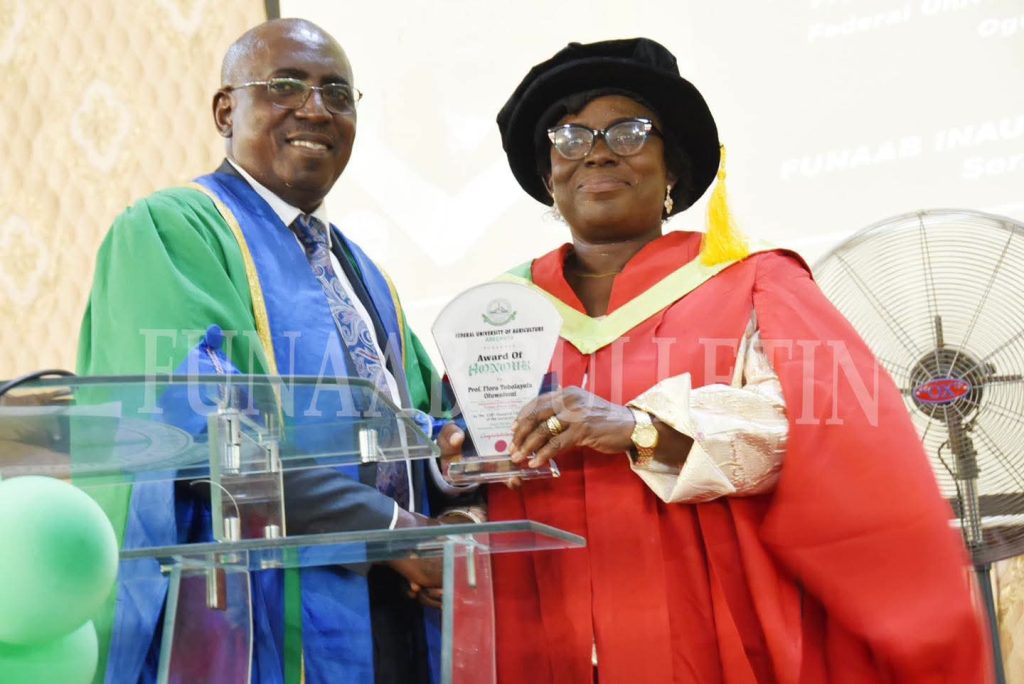
He commended her service and her work in projecting the university’s image beyond its immediate environment, particularly through her leadership at NMU. He called her a worthy ambassador of FUNAAB.