

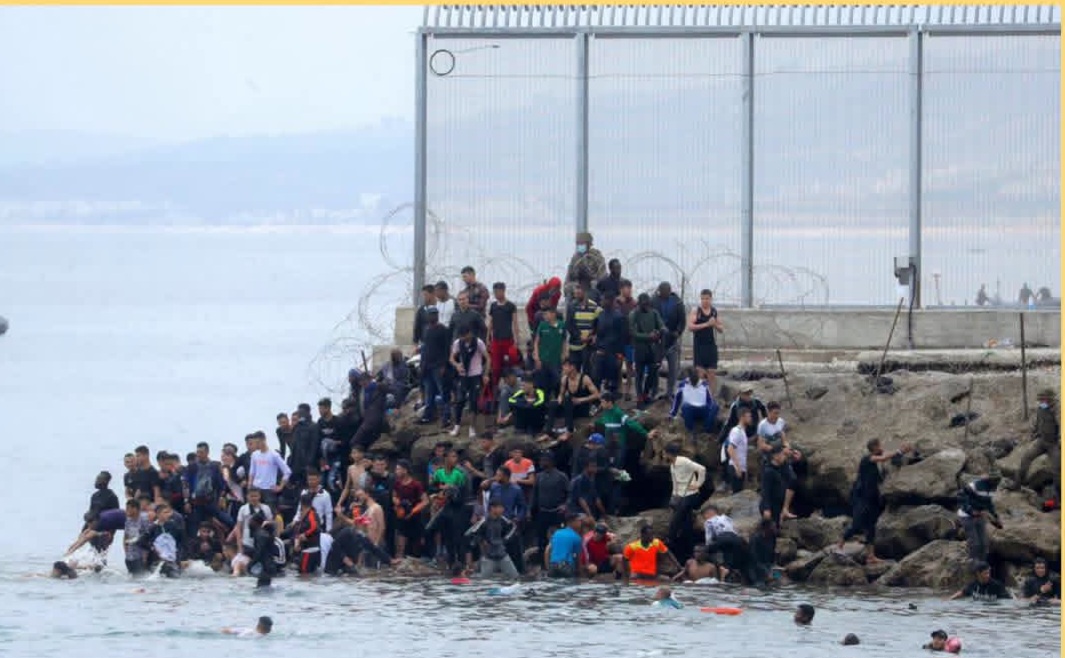
MADRID — A monumental migration crisis erupted this week in the Spanish North African enclave of Ceuta, where an unprecedented influx of approximately 60,000 migrants crossed from Morocco in a mere 24-hour window. The historic surge has overwhelmed the enclave—home to roughly 85,000 residents—and left at least 60 people dead from drowning and fatal crushes at the Tarajal beach breakwater.
Spanish Prime Minister Pedro Sánchez, who traveled to Ceuta on Friday, denounced the mass crossing as an assault on the nation’s territorial sovereignty. Addressing the crisis, Sánchez attributed the sudden wave to criminal human trafficking syndicates. These networks allegedly exploited a recent Spanish Supreme Court ruling that halted the immediate deportation of migrants intercepted en route to Ceuta or Melilla.
”That has spread like wildfire during these last few hours through the networks of mafias that traffic in human beings and has produced an avalanche of the characteristics and dimension that we experienced yesterday,” Sánchez stated.
To restore order, Madrid has deployed additional police and military forces to the enclave. The government announced plans to construct a temporary triage and processing hub to expedite the deportation of individuals lacking a legal basis to stay. Furthermore, authorities will install a visible buoy barrier near Tarajal beach to clearly define maritime borders while adhering to judicial mandates.

By Friday afternoon, Spain’s Interior Ministry reported that more than 37,500 migrants had voluntarily returned to Morocco. Still, local observers describe the situation on the ground as chaotic. Rachid Sbihi, leader of a Guardia Civil workers’ association, noted that thousands of individuals, including unaccompanied minors, remain stranded without shelter, sleeping on pavement and in public parks.
The domestic crisis quickly spilled over into international diplomatic friction. Rome announced a temporary one-month suspension of Schengen free-travel arrangements with Spain. While the two nations share no land border, the decree mandates passport controls for all air and sea travelers moving between them. Additionally, Italian and French authorities agreed to reinforce patrols along the Franco-Italian corridor to preempt secondary movements.
The move drew sharp condemnation from Madrid after Italian Foreign Minister Antonio Tajani publicly blamed Spain’s migration policies for incentivizing trafficking networks. In response, Spanish Foreign Minister José Manuel Albares summoned the Italian ambassador, labeling Tajani’s remarks “unbecoming” and accusing Rome of engaging in partisan posturing.
The European Commission intervened to clarify that Ceuta and Melilla maintain distinct legal exemptions that block migrants from automatically entering the broader Schengen area. EU Migration Commissioner Magnus Brunner condemned the events in Ceuta as “unacceptable” and confirmed active coordination with Spanish counterparts.
Meanwhile, diplomatic backing for Madrid materialized from Dublin. Irish Justice Minister Jim O’Callaghan extended solidarity to Spain’s Interior Minister Fernando Grande-Marlaska. Acting under Ireland’s Presidency of the Council of the European Union, O’Callaghan formally requested an emergency session of the EU’s Integrated Political Crisis Response mechanism alongside a summit of European ambassadors.
Moroccan officials defended Rabat’s counter-trafficking efforts, emphasizing that bilateral cooperation with Spain remains robust, even as international scrutiny intensifies over the worst border breach since the May 2021 crisis.
Do you want to advertise with us?
Do you need publicity for a product, service, or event?
Contact us on WhatsApp +2348033617468, +234 816 612 1513, +234 703 010 7174
or Email: validviewnetwork@gmail.com
CLICK TO JOIN OUR WHATSAPP GROUP